The Department of Labor recently revealed that the economy lost 80,000 jobs in March. In response, politicians have cried out for more generous government bailouts and stimulus packages. 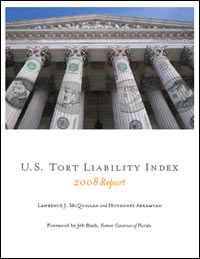
But if our leaders were serious about stimulating the economy, they’d turn to something more unorthodox — meaningful tort reforms.
Abuse of America’s tort system is a significant drag on our economy. In our 2008 U.S. Tort Liability Index, we chronicle this fact and lay out common-sense reforms that would do wonders for economic growth.
Direct tort costs, which include lawyers’ fees and plaintiff awards, account for more than 2 percent of U.S. gross domestic product annually. That’s equivalent to what the federal government spent last year on public education, transportation, agriculture, energy and scientific research, combined. That number balloons to $865 billion if you factor in indirect economic costs, like the loss of new products that are never brought to market because of the potential for devastating tort payouts.
Worse, the tort system is wasteful. Just 15 cents of every tort dollar goes to injured plaintiffs.
The system directly impacts employment. According to a McKinsey & Company study, tort risks are second only to the availability of qualified workers in significance for a company when deciding where to expand.
In 2003, for example, corporate titan Phillip Morris almost went bankrupt as a result of an adverse tort ruling. After losing a hundred-billion dollar lawsuit in Illinois, the company tried to appeal the decision. But to do so, state law required a $12 billion bond payment. Phillip Morris was effectively forced to choose between going out of business and foregoing due process.
This example corresponds with the Index’s data. Illinois not only has among the worst tort laws in the nation, it also produces some of the highest monetary losses from tort — over $8 billion in 2006.
In response to such unfriendly climes, companies have flocked to states with common-sense regulatory environments. That’s meant a windfall for places like Georgia, which caps appeal bonds at $25 million for civil cases. Oklahoma caps attorneys’ contingency fees to 50 percent of the plaintiff’s recovery. Such a policy reduces attorneys’ temptation to exploit plaintiffs and deep-pocketed defendants. It’s no surprise, then, that we found Georgia and Oklahoma to have among the best tort laws in the nation — in fourth and 13th place, respectively.
Tort laws also affect economic growth. In 2006, state-level GDP grew 25 percent faster in the 10 states with the best tort systems than in the 10 states with the worst. By another calculation, implementing just six common tort reforms boosts a state’s employment rate by 1 percent.
Politicians who are nervous about the stumbling economy should take a long look at the tort system and the hundreds of billions of dollars of economic activity it impacts. The numbers are clear — the best stimulus package for our economy is tort reform.

An effective stimulus package
Lawrence J. McQuillan
The Department of Labor recently revealed that the economy lost 80,000 jobs in March. In response, politicians have cried out for more generous government bailouts and stimulus packages.
But if our leaders were serious about stimulating the economy, they’d turn to something more unorthodox — meaningful tort reforms.
Abuse of America’s tort system is a significant drag on our economy. In our 2008 U.S. Tort Liability Index, we chronicle this fact and lay out common-sense reforms that would do wonders for economic growth.
Direct tort costs, which include lawyers’ fees and plaintiff awards, account for more than 2 percent of U.S. gross domestic product annually. That’s equivalent to what the federal government spent last year on public education, transportation, agriculture, energy and scientific research, combined. That number balloons to $865 billion if you factor in indirect economic costs, like the loss of new products that are never brought to market because of the potential for devastating tort payouts.
Worse, the tort system is wasteful. Just 15 cents of every tort dollar goes to injured plaintiffs.
The system directly impacts employment. According to a McKinsey & Company study, tort risks are second only to the availability of qualified workers in significance for a company when deciding where to expand.
In 2003, for example, corporate titan Phillip Morris almost went bankrupt as a result of an adverse tort ruling. After losing a hundred-billion dollar lawsuit in Illinois, the company tried to appeal the decision. But to do so, state law required a $12 billion bond payment. Phillip Morris was effectively forced to choose between going out of business and foregoing due process.
This example corresponds with the Index’s data. Illinois not only has among the worst tort laws in the nation, it also produces some of the highest monetary losses from tort — over $8 billion in 2006.
In response to such unfriendly climes, companies have flocked to states with common-sense regulatory environments. That’s meant a windfall for places like Georgia, which caps appeal bonds at $25 million for civil cases. Oklahoma caps attorneys’ contingency fees to 50 percent of the plaintiff’s recovery. Such a policy reduces attorneys’ temptation to exploit plaintiffs and deep-pocketed defendants. It’s no surprise, then, that we found Georgia and Oklahoma to have among the best tort laws in the nation — in fourth and 13th place, respectively.
Tort laws also affect economic growth. In 2006, state-level GDP grew 25 percent faster in the 10 states with the best tort systems than in the 10 states with the worst. By another calculation, implementing just six common tort reforms boosts a state’s employment rate by 1 percent.
Politicians who are nervous about the stumbling economy should take a long look at the tort system and the hundreds of billions of dollars of economic activity it impacts. The numbers are clear — the best stimulus package for our economy is tort reform.
Nothing contained in this blog is to be construed as necessarily reflecting the views of the Pacific Research Institute or as an attempt to thwart or aid the passage of any legislation.