There is good and bad with Alabama’s health, health care and health delivery systems.
We do have a number of health disparities and challenges. Alabama has the nation’s highest rate of stroke, second-highest rate of obesity and the third-highest rate of infant mortality.
However, a recent study concludes that Alabama has some real cause for celebration right now in another realm of health care. That is the state’s improvement in something that directly affects the lives of every Alabama citizen: health ownership.
Put simply, “health ownership” is the degree to which people are free to make their own health care decisions.
Consider someone who’s unable to buy a low-cost health insurance package that meets her needs. Or an expectant mother who can’t find an obstetrician nearby because high malpractice insurance rates have driven many doctors out of practice.
Both patients have little control over their health care decisions, thanks to onerous intervention by the government.
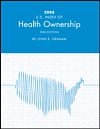
Fortunately, these problems are rarer in Alabama than anywhere else in the country. In the Pacific Research Institute’s annual state-by-state ranking of health ownership, Alabama came out on top for the first time.
Indeed, Alabamians have nearly twice as much control over their health care as people in the bottom-ranked state, New York.
That’s a big reason why Alabamians spend $1,400 less per capita on health care each year than New Yorkers.
States with high levels of health ownership expend just a fraction of what states with low levels do. In an era of persistent state budget crises, lawmakers would be wise to improve health ownership as a means of keeping costs under control.
One way of doing so? Getting rid of health benefit mandates. These are the services that states decree insurance providers must cover.
They range from the reasonable (emergency services in Arkansas) to the ridiculous (port-wine stain elimination in Minnesota).
In 1979, there was an average of five mandates per state. That number has risen to 32 now.
All those legal requirements make insurance more expensive. The Council for Affordable Health Insurance estimates that benefit mandates increase the cost of basic health coverage by 20 to 50 percent, depending on the state.
Mandating in vitro fertilization, for example, increases the cost of a policy by 3 to 5 percent.
Mandates can put health insurance out of reach for many unemployed and underemployed Americans. They also lower the wages of those who have insurance.
Alabama, though, is setting an example on this issue. The state imposes just 19 benefit mandates. (New York has almost three times that number.)
Alabama also maintains effective controls on its state health programs, protecting taxpayers from out-of-control spending.
For example, Alabama reserves its Medicaid program for the truly needy. Older children are eligible for Medicaid only if their family incomes are below the federal pover ty line. Younger children are eligible if their family incomes fall below 133 percent of the line.
By contrast, Minnesota extends Medicaid to everyone who earns less than 275 percent of the federal poverty line — or $58,300 for a family of four.
Such state largesse hits middle-class families where it counts — in their wallets. After all, the larger the Medicaid rolls the more expensive the program becomes, and the more taxpayers must spend to maintain it.
Bloated Medicaid rolls also hurt taxpayers because of government price controls on the rates doctors receive to treat Medicaid patients.
Across the board, these reimbursements are well below market rate. Doctors can’t stay in business with such losses, so they make up the difference by charging more to those who pay on their own or with private insurance.
Despite leading the way on health ownership, Alabama does have some room for improvement.
For instance, the state burdens many health care providers with excess regulation. Alabama’s nurse practitioners face one of the most restrictive scopes of practice in the nation, according to the Center for the Health Professions at the University of California-San Francisco.
Almost every other state lets nurse practitioners prescribe controlled substances. If an Alabamian needs a prescription, he’ll have to pay more for a doctor visit — and he might have to wait a significant and unnecessary period of time for an appointment.
Nevertheless, Alabama leads the way when it comes to empowering its citizens to take control of their health care decisions. The rest of the country could stand to take a few pointers from Alabama’s contributions to inventing a better and secure health care future for all.

Winning diagnosis
John R. Graham
There is good and bad with Alabama’s health, health care and health delivery systems.
We do have a number of health disparities and challenges. Alabama has the nation’s highest rate of stroke, second-highest rate of obesity and the third-highest rate of infant mortality.
However, a recent study concludes that Alabama has some real cause for celebration right now in another realm of health care. That is the state’s improvement in something that directly affects the lives of every Alabama citizen: health ownership.
Put simply, “health ownership” is the degree to which people are free to make their own health care decisions.
Consider someone who’s unable to buy a low-cost health insurance package that meets her needs. Or an expectant mother who can’t find an obstetrician nearby because high malpractice insurance rates have driven many doctors out of practice.
Both patients have little control over their health care decisions, thanks to onerous intervention by the government.
Fortunately, these problems are rarer in Alabama than anywhere else in the country. In the Pacific Research Institute’s annual state-by-state ranking of health ownership, Alabama came out on top for the first time.
Indeed, Alabamians have nearly twice as much control over their health care as people in the bottom-ranked state, New York.
That’s a big reason why Alabamians spend $1,400 less per capita on health care each year than New Yorkers.
States with high levels of health ownership expend just a fraction of what states with low levels do. In an era of persistent state budget crises, lawmakers would be wise to improve health ownership as a means of keeping costs under control.
One way of doing so? Getting rid of health benefit mandates. These are the services that states decree insurance providers must cover.
They range from the reasonable (emergency services in Arkansas) to the ridiculous (port-wine stain elimination in Minnesota).
In 1979, there was an average of five mandates per state. That number has risen to 32 now.
All those legal requirements make insurance more expensive. The Council for Affordable Health Insurance estimates that benefit mandates increase the cost of basic health coverage by 20 to 50 percent, depending on the state.
Mandating in vitro fertilization, for example, increases the cost of a policy by 3 to 5 percent.
Mandates can put health insurance out of reach for many unemployed and underemployed Americans. They also lower the wages of those who have insurance.
Alabama, though, is setting an example on this issue. The state imposes just 19 benefit mandates. (New York has almost three times that number.)
Alabama also maintains effective controls on its state health programs, protecting taxpayers from out-of-control spending.
For example, Alabama reserves its Medicaid program for the truly needy. Older children are eligible for Medicaid only if their family incomes are below the federal pover ty line. Younger children are eligible if their family incomes fall below 133 percent of the line.
By contrast, Minnesota extends Medicaid to everyone who earns less than 275 percent of the federal poverty line — or $58,300 for a family of four.
Such state largesse hits middle-class families where it counts — in their wallets. After all, the larger the Medicaid rolls the more expensive the program becomes, and the more taxpayers must spend to maintain it.
Bloated Medicaid rolls also hurt taxpayers because of government price controls on the rates doctors receive to treat Medicaid patients.
Across the board, these reimbursements are well below market rate. Doctors can’t stay in business with such losses, so they make up the difference by charging more to those who pay on their own or with private insurance.
Despite leading the way on health ownership, Alabama does have some room for improvement.
For instance, the state burdens many health care providers with excess regulation. Alabama’s nurse practitioners face one of the most restrictive scopes of practice in the nation, according to the Center for the Health Professions at the University of California-San Francisco.
Almost every other state lets nurse practitioners prescribe controlled substances. If an Alabamian needs a prescription, he’ll have to pay more for a doctor visit — and he might have to wait a significant and unnecessary period of time for an appointment.
Nevertheless, Alabama leads the way when it comes to empowering its citizens to take control of their health care decisions. The rest of the country could stand to take a few pointers from Alabama’s contributions to inventing a better and secure health care future for all.
Nothing contained in this blog is to be construed as necessarily reflecting the views of the Pacific Research Institute or as an attempt to thwart or aid the passage of any legislation.