
Californians Will Pay a High Price for Tom Steyer’s “Split-Role” Proposal
Wayne Winegarden
March 2026
Gubernatorial candidate Tom Steyer supports “a special election to raise corporate taxes in his first year as governor.” Specifically, he favors removing the Proposition 13 tax limitations for commercial properties – an idea referred to as “spit-roll”. If implemented, split-roll will further worsen California’s business environment to the detriment of state residents.
Proposition 13, passed in 1978, is one of the few protections that taxpayers have against ever-rising taxes in the state. Further, as we document in our January 2026 Spending Watch analysis of Governor Newsom’s FY2026-27 budget, California does not suffer from insufficient tax revenues. It suffers from excessive spending, which remains well above California’s historical average.
Implementing split-roll will impose a significant tax increase on California’s businesses, who already face the third worst tax environment in the nation – only New Jersey and New York are worse. Increasing the property tax burden on commercial and industrial properties will further widen the cost differential for in-state businesses compared to their national and international competitors. Several adverse consequences will follow.
Due to the reduced profitability, businesses in California will be less able to increase salaries and wages for their employees, which will reduce overall income growth for families in California. In addition to decreased income growth for workers, the profitability of businesses operating in California will decrease. This decreased profitability will incentivize more businesses to join the exodus from the state and relocate business activity elsewhere.
Families will also pay higher costs as California-based businesses, especially retail businesses, raise prices in an attempt to manage their now higher costs of doing business. The affordability problems plaguing many California families will worsen as a result.
Making these impacts even worse, these impacts will likely harm small businesses and entrepreneurial start-ups to a greater extent. As with all regulations, small businesses have less resources at their disposal to manage the higher costs that the split-roll proposal would create.
Accounting for all these costs, the economic impact from adopting the split-roll proposal will be significant. To get a sense of these costs, according to a 2020 analysis of the split-roll policy, the Legislative Analyst’s Office (LAO)estimates that the proposal would raise between $8.0 billion and $12.5 billion in higher property tax revenues.
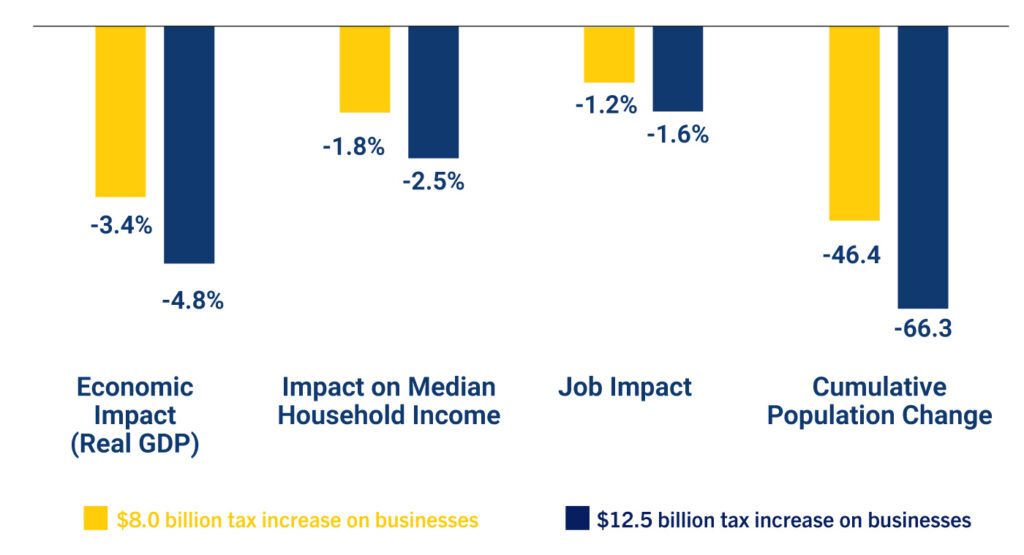
Using PRI’s economic and tax model to estimate the impact from an $8.0 billion to $12.5 billion tax increase on California’s businesses, we estimate that, within five years, the size of California’s economy could shrink between 3.4 percent and 4.8 percent relative to the baseline. Further, the growth in the average household’s income would be between $2,170 and $3,090 smaller, the growth in jobs would between 225,000 and 322,000 less, and the exodus of people from the state would increase between 46,000 and 66,000.
KEY TAKEAWAYS
- Proposition 13 is one of the few taxpayer protections that Californians have.
- Removing these protections for commercial properties will further worsen the state’s business environment and impose a larger burden on small businesses and entrepreneurial start-ups.
- Based on the Legislative Analyst’s Office 2020 estimate that adopting the split-roll will raise between $8 billion and $12.5 billion, the proposal will reduce economic growth by up to 4.8 percent, reduce the growth in the average household’s income by up to $3,090, diminish the growth in jobs by up to 322,000 positions, and accelerate the exodus from the state by up to 66,000 people.
5-Year Economic Impact Compared to Baseline
(population change in thousands)
Conclusion
Californians are already over-taxed. Proposition 13 is one of the few taxpayer protections left preventing the state from becoming the least competitive state in the country. Adopting the split-roll policy shatters this protection and subjects the state to a significant tax increase that will reduce prosperity. Rather than undermining the few taxpayer protections left, Californians should demand their policy leaders adopt a fiscally responsible budget that ensures programs achieve better results while spending less. Ultimately, the path to sustainable state and local budgets requires a vibrant private economy. Raising taxes undermines this vital goal.