

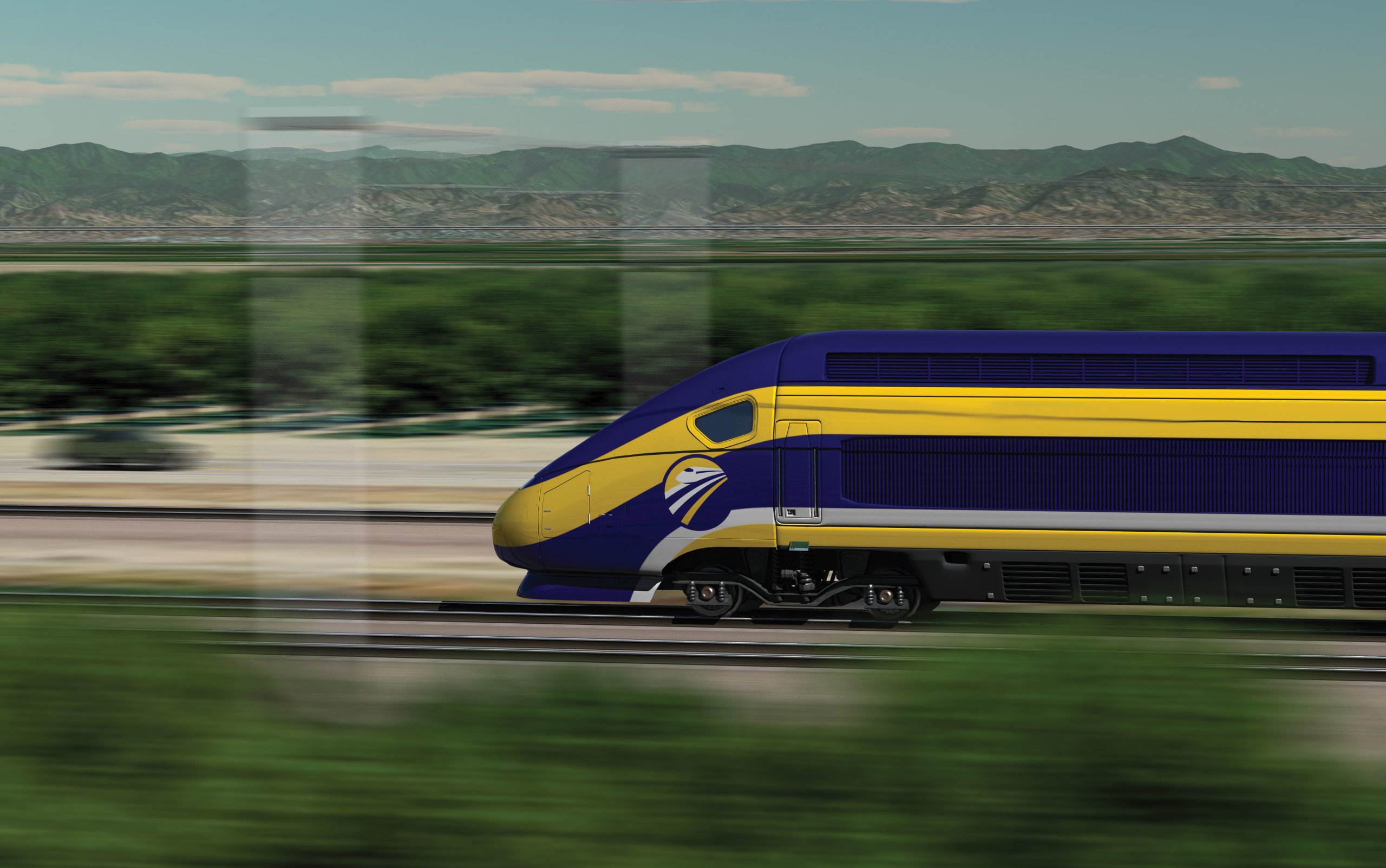
It’s happening. This time, it’s really happening.
That’s what dignitaries at the pseudo-event told themselves on April 22, 2024 — the day Brightline West “officially broke ground on the nation’s first true high-speed rail system.”
Bureaucrats, politicians, and civic leaders predicted nothing but sunshine for the long-sought HSR route linking Southern California and Las Vegas. U.S. Secretary of Transportation Pete Buttigieg praised “one of the very best examples of America’s infrastructure comeback.” U.S. Rep. Jay Obernolte, R-Calif., extolled a “convenient alternative to driving [that] will reduce the number of cars on the road, decreasing emissions and reducing congestion in our High Desert communities.” U.S. Senator Jacky Rosen, D-Nev., swooned over “the beginning of a new era for southern Nevada.”
Twenty-eight months later, Brightline West looks more and more like yet another SoCal-to-Sin City dead end. Delays, an enormous cost overrun and a looming financial calamity for an affiliated railroad threaten doom. Consequences of a flameout would be cruel to both taxpayers and investors.
Brightline West’s boosters are probably shocked by the reversal of fortune. Veteran transportation researchers aren’t. HSR connecting greater Los Angeles and Las Vegas has always been more razzle-dazzle than brass tacks. In 1988, Sacramento and Carson City created the California-Nevada Super Speed Train Commission (CNSSTC). Two years later, eight commissioners journeyed — at taxpayer expense — to France and Germany, for a firsthand look at how Europeans were progressing with state-of-the-art passenger rail.
The CNSSTC granted Bechtel a “conditional franchise” to build a magnetic-levitation line from Anaheim to Las Vegas. The construction firm, then based in San Francisco, submitted the only bid, the Los Angeles Times reported, because “Morrison-Knudsen and Bombardier Corp. … pulled out of the competition, saying that the lack of public financing for environmental planning made the project ‘excessively risky’ to would-be financial backers.”
The years dragged on, funding was not found, and Bechtel bailed. But believers never lost faith. In 1997, newcomer “American Magline Group,” based in Los Angeles, replaced Bechtel. The CNSSTC’s chairman, a Las Vegas attorney, claimed that everything was “falling into place,” and there was “no question this will work.” (“Can you imagine getting your kids on a train at 9 a.m. and seeing Mickey and Minnie by 10:30 a.m.?”) It took nearly another decade, but the public-private partnership nabbed a $45 million earmark from the Bush administration for studies.
The maglev’s first phase, from Las Vegas to the California border, looked imminent. Then, disaster. A key supporter flip-flopped. In June 2009, Harry Reid, the dean of Nevada’s congressional delegation — and majority leader of the U.S. Senate — switched his endorsement from the establishment-backed maglev line (he slammed its “30-year record of failure”) to a new player: upstart DesertXpress Enterprises. Worse, he redirected the federal subsidy to road improvements around the airport that would one day bear his name.
DesertXpress sought to link Las Vegas to Victorville with electric trains — and spend zero “public tax dollars” doing it. Construction was set to commence in March 2010. You know the rest. Costs more than doubled. Investors balked. Attempts to secure a federal loan fizzled. The Washington Post wondered “if this train is such a good idea, business-wise, how come private banks aren’t lining up to finance it?”
Even a name change didn’t help — in 2012, DesertXpress became XpressWest, “to more accurately reflect its role as the first leg of a larger western high-speed passenger rail network.” By the mid-2010s, prospects grew so dim, U.S. Rep. Dina Titus, D-Nev., pushed for the restoration of Amtrak’s super-slow service — eliminated in 1997 — “as a temporary solution to help us bridge the gap until we have a financially viable high-speed rail project.”
In 2018, it was time for another round of good vibes. Brightline, owned by the behemoth Fortress Investment Group, acquired what was left of XpressWest. With a passenger train already underway in Florida — stretching from Miami to Fort Lauderdale, with plans to reach Orlando — the company’s co-founder and co-CEO asserted that “private-sector investment has a meaningful role to play in developing transportation infrastructure.” Brightline West would break ground in 2020, and begin service in 2022.
The COVID-19 lockdown, of course, torpedoed such a rosy schedule. But as life gradually returned to normal, Brightline West forged confidently ahead. Even skeptics admitted that obstacles were dwindling. Landowners unwilling to sell? California and Nevada contributed their rights-of-way within, and alongside, I-15 for the placement of tracks. Environmental opposition? California approved three overcrossings to “provide a sustainable and safe path for wildlife — especially for bighorn sheep.” Not enough money? The Biden administration delivered a $3 billion grant from the Federal-State Partnership for Intercity Passenger Rail Grant Program, and Brightline West qualified to issue billions of dollars in tax-exempt private activity bonds. And … Victorville? A Rancho Cucamonga connection was added, for access to Metrolink’s system of commuter trains throughout greater Los Angeles.
With so much in its favor, how can Brightline West be stumbling toward collapse? The trouble started in October, when Bloomberg discovered that construction costs had “swelled by nearly 35%,” rising from $16 to $21.5 billion. Capitulating to Big Labor, via a project labor agreement, certainly didn’t help. A $6 billion loan from D.C.’s Railroad Rehabilitation and Improvement Financing program might not happen. The goal of bringing service online by the 2028 Olympics Games in Los Angeles is kaput. And Brightline’s debt-laden, credit-rating-challenged Florida operation is on the verge on bankruptcy. Its ridership estimate for 2025 was off by 54%, and subpar tickets sales struggle to raise the revenue needed to repay bondholders.
As The Nevada Independent’s Michael Schaus observed, “even if everything was on schedule and funding had been secured, there would still be reasons to doubt [Brightline West] would be as transformational and impressive as advocates suggest.” Are the company’s ridership projections as flawed as its East Coast counterpart’s were? Five airports in the Los Angeles metro region supply flights to Las Vegas. As for driving, congestion on I-15 isn’t what it used to be, given Sin City’s sagging tourism.
When even “private” efforts to revive intercity passenger rail cannot work, it’s time to recognize an incontrovertible fact: Americans fly or drive between metro areas. They’ve put trains permanently in the nation’s past.
D. Dowd Muska is a researcher and writer who studies public policy from the limited-government perspective. A veteran of several think tanks, he writes a column and publishes other content at No Dowd About It.
(Image courtesy California High Speed Rail Authority)