
Ag-to-Urban law creates a farmer’s market
for Arizona housing
By D. Dowd Muska | January 9, 2026
If it unites farmers, developers and environmentalists, it’s probably a sound policy reform.
Some observers consider Senate Bill 1611, approved last summer by a GOP-majority Legislature and a Democratic governor, “one of the most significant pieces of legislation in Arizona’s history.” Known as the Ag-to-Urban bill, advocates believe it will offer relief to the shelter-seeking newcomers who pour into the Grand Canyon State at a relentless rate.
The need for action isn’t in doubt. The latest edition of “State of Housing in Arizona” found that “demand continues to outpace housing growth,” while “[h]ousing costs continue to outpace earnings.” In September, the Common Sense Institute calculated that Arizona suffers from “an immediate housing shortage of 52,846 units,” yet “the annualized pace of permitting through Q2 fell nearly 12.5% relative to 2024 totals and the state is now on pace to never close the current deficit (absent other changes).”
At first glance, it might appear that the West’s never-ending water squabbles are no impediment to housing expansion in Arizona. As unimaginable as it may seem, despite a nearly sevenfold increase in population, the state consumed about the same amount of water in 2017 as it did in 1957.
Much of the savings can be explained by command-and-control government intervention in urban zones. In 1980, more than three decades before California followed suit, the Grand Canyon State adopted a sweeping groundwater law. Central to the measure was the formation of Active Management Areas (AMAs) — there are currently seven, and there is consistent pressure to create more. Greens’ support for the jurisdictions is easy to grasp, given the entities’ breadth and depth. As the Arizona Municipal Water Users Association brags, within AMAs, “conservation programs and practices are mandatory,” developers “can’t create new subdivisions without a 100-year assured water supply” and farms “can’t irrigate new fields.”
The system “worked,” until 2021, when the state ruled that “groundwater depletion and the resulting unmet demand for groundwater supplies” plagued the AMA just south of Phoenix. Thus, developments that planned to rely “solely on groundwater” were essentially banned. Two years later, the Phoenix AMA itself faced a similar moratorium, when Gov. Katie Hobbs announced that a new “groundwater model projection” showed that “over a period of 100 years,” around “4% of the demand for groundwater … in the region will not be met without further action.”
National media and eco-scolds celebrated. To them, the go-go era for America’s 10th-largest metro area, a willfully blind megalopolis foolishly located in a severely arid region, was over. The New York Times nattered that the governor’s decision “could be a glimpse of the future as climate change batters the West.” The Environmental Defense Fund harumphed that the “water supply limits demonstrated by this new analysis” made it clear that “[u]nbridled sprawl” was “never sustainable.”
But back at home, opposition mounted. The booming city of Buckeye thundered that the governor’s “pause” was a “reactionary response to an exaggerated issue.” And the Home Builders Association of Central Arizona mounted a legal challenge that has yet to be resolved.
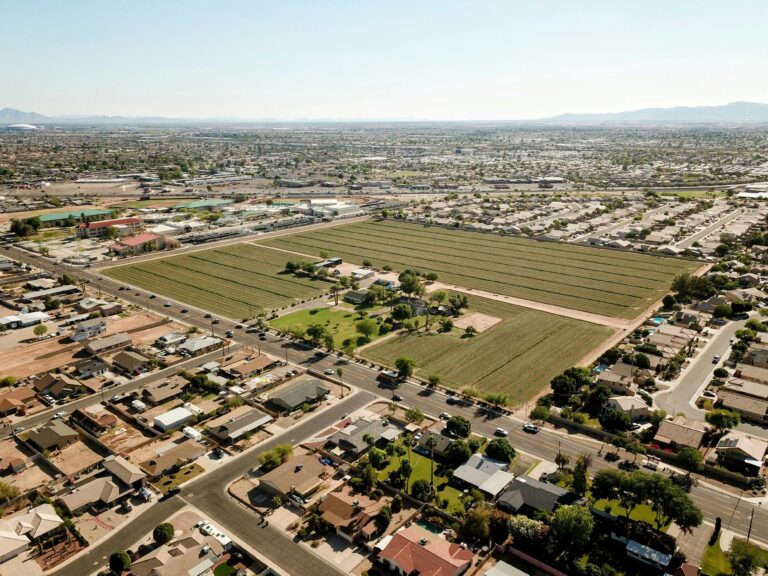
Luckily, elected officials, water wonks, activists and businesses had spent the previous few years crafting a reform that promised a partial — and market-oriented — solution. Ag-to-Urban, per the Courthouse News Service, empowers farmers to voluntarily “relinquish groundwater rights in exchange for credits of physical water availability, then sell the land and water rights to … developers to build new communities with a lower water demand.” Far from a boutique alteration destined to have little impact, the opportunity for conversion is substantial. As the Arizona Daily Star noted, metro Phoenix retains “hundreds of thousands of acres of farmland … even after hundreds of thousands more acres have been paved over for development since World War II.”
Championed by GOPers in the state Senate — who touted Ag-to-Urban as a means to address “Arizona’s most pressing issues: groundwater protection and skyrocketing home prices due to low supply” — SB 1611 passed both chambers by wide margins. Republicans felt comfortable voting for the bill, given its solid backing from the agriculture community.
The Arizona Cattle Feeders Association got on board, as did the Arizona Cotton Growers Association. Rep. Gail Griffin, R-Hereford, called the legislation a win for both “farmers who are ready to retire” and “Arizona families that want the American dream of homeownership.” For the record, commercial and industrial customers are allowed to purchase water formerly used for irrigation, too. Many Democrats embraced Ag-to-Urban, given its endorsement by several “environmental” organizations. The National Audubon Society, for example, approved of the provision that water from “retired agricultural acres” is verboten “for non-functional grass, waterparks, lakes, ponds and decorative water features.”
At SB 1611’s signing ceremony, Hobbs beamed that the “historic” deal will “save millions of acre-feet of water, help lower the cost of housing, and create jobs.” Babbitt, a green cultist who served two terms as Arizona governor and was President Bill Clinton’s secretary of the Interior, praised Ag-to-Urban as “good for our aquifers, good for our residents and good for our farmers.”
But the political dealmaking may have been the easy part. Now comes a task that could prove tougher: implementation. The immensely powerful Arizona Department of Water Resources has until June 30, 2026, to finalize key Ag-to-Urban regulations. Pro-housing forces must closely monitor the bureaucracy’s rulemaking to ensure that the intent of the legislative branch is not strangled by the self-interest of the executive branch.
SB 1611 is far from perfect. As a prominent Phoenix law firm observed, “immense compromise … went into this bipartisan legislation.” But by injecting a strong dose of marketization into a water-allocation matrix dominated by government — and thus, politics — it’s difficult to argue with the Arizona Water Co.’s claim that Ag-to-Urban makes the Grand Canyon State “a national leader in innovative water policy.”