
Congestion in 2025:
US cities fare well by international standards
When measured by the amount of hours each commuter wastes in traffic per year, Lima, Peru, was the most congested city in the world in 2025, according to TomTom’s traffic index ranking. This was followed by Dublin, Ireland; Mexico City; and Bucharest, Romania. The first U.S. city on the list of 492 cities was New York and it was only number 46.
Rather than hours wasted in traffic, TomTom’s press release indicates that it prefers to use a different measure of congestion, namely the percentage of extra time required to travel during rush hour compared with uncongested times of the day. By that measure, known as the travel time index, Los Angeles is the worst-congested city in the United States. However, I don’t find either of these measures very satisfactory.
According to TomTom, the average New York City traveler wastes 125 hours a year sitting in traffic, while the average Los Angeles commuter wastes only 83 hours a year. But average speeds in Los Angeles are 24 miles an hour while the average speeds in New York are less than 12 miles per hour. Congestion increases travel times by 59.8% in Los Angeles but only 48.8% in New York, so TomTom regards Los Angeles to be worse. But during congestion, average speeds in Los Angeles are 17.1 mph while they are less than 10 mph in New York, and I’d rather be going 17 than 10.
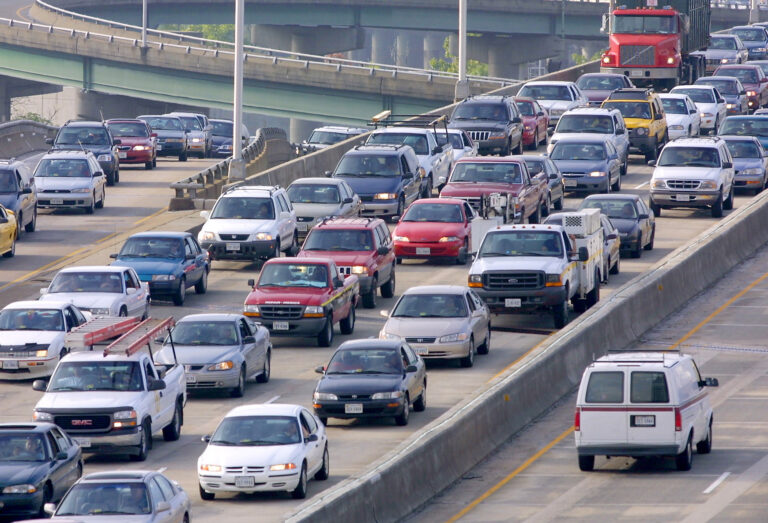
Both indexes compare travel during rush hour with travel during uncongested times of the day. However, this misses the extent of congestion: do “rush-hour” congestion last for just one hour or most of the day? TomTom’s data shows about three hours of slow speeds per weekday in Phoenix but 12 hours in Los Angeles and New York.
If traffic must be reduced to a single number, a better index would be the average of overall travel speeds. If those speeds are higher, then rush-hour speeds are also higher. I suspect most people would rather travel 30 miles per hour during rush hour, even if that was significantly slower than during non-rush hours, than travel only 10 or 15 mph during rush hour even if that was only slightly slower than during non-rush hours.
Most European cities in TomTom’s ranking have average speeds in the teens, with 169 out of 252 European cities having average speeds under 20 mph. By comparison, only nine out of 91 U.S. cities are slower than 20 mph. London is only 10.8 mph; Paris is 12.4. Yet London ranks as only the 75th-worst city on the travel time index and Paris is way below that at 231. Meanwhile, Los Angeles is supposed to be the 25th-worst city even though its average speed during rush hour is 17.1 mph, faster than the average overall speeds in more than 100 European cities.
In Phoenix, the average speed is 30.9 mph during rush hour, which is more than the average speed over an entire day in all but four (out of 262 measured) European cities. Over the course of an entire day, the average speed in Phoenix is 40 mph. If I lived in Phoenix, I might be annoyed by 30% slower rush-hour speeds, but I would be even more annoyed if I had to live in a city whose average speeds were below 20 mph.
The above numbers are for cities, but TomTom also has numbers for what it calls metro areas. Based on TomTom’s definition. This corresponds to what the Census Bureau calls urban areas. Twenty-three of the 25 fastest metro areas in the world are in the United States, with Phoenix being number 5. (The two others are in Italy.) In the Phoenix metro area, average speeds are 40.5 mph, slowing moderately to 34.5 during rush hour.
Despite being one of the fastest growing urban areas in the country, Phoenix has kept up with growth with an aggressive freeway construction program that proves cities can minimize congestion by building new roads. In contrast, the Portland, Ore., metro area hasn’t opened a new freeway since 1982 and its average speeds are 29.1 over the course of a day and 24 at rush hour. Los Angeles has the fewest miles of freeway per million people of any major urban area in the U.S., and its metro area speeds average 27.6 slowing to 21.1 during rush hour.
No doubt someone will respond that Europeans and New Yorkers can avoid congestion by taking transit, but average transit speeds are even lower. Nationwide, U.S. transit speeds averaged 14.9 mph in 2024, while transit average 14.7 in the New York urban area and 12.6 in New York City. That doesn’t include time waiting for buses or trains, waiting for transfers, or walking to and from transit stops, which is why cars provide access to far more jobs than transit even in New York.
Unfortunately, the TomTom report makes it difficult to compare large numbers of urban areas. The ranking tables can easily be sorted by different values such as the travel time index or average speeds, but I haven’t figured out a way to copy and paste them to an Excel file to make more detailed calculations. Moreover, most of the data found for individual cities or metro areas such as Phoenix and Portland are not in the tables, making interurban comparisons even more tedious.
One thing is certain: the United States has the fastest urban speeds on the planet, whether measured for cities or urban areas and whether during rush hour or non-rush-hour periods. Research has shown that higher travel speeds correlate with higher worker productivity because employers have access to more workers that are better suited to their jobs.
Within the United States, the fastest cities and metro areas may be more than twice as fast as the slowest, but only one metro area and nine cities average less than 20 mph. Relieving congestion is an important goal, but increasing average speeds is even more important and one that the slower U.S. cities and metro areas should place higher on their priority lists.
This column was first published by the Anti-Planner and is reprinted with permission.