
Hailing a flight: Cities drone on about advanced air mobility
By D. Dowd Muska | February 27, 2026
It’s time to talk about flying taxis.
Snicker all you want, but serious people — and deep pockets — are committing considerable resources to making airborne intra-city travel a thing. What the FAA calls Advanced Air Mobility (AAM) — “a collection of new and emerging technologies being applied to the aviation transportation system, particularly in new aircraft types” — could substantially enhance the way urbanites move around. Elected officials, policy wonks and concerned citizens should take notice.
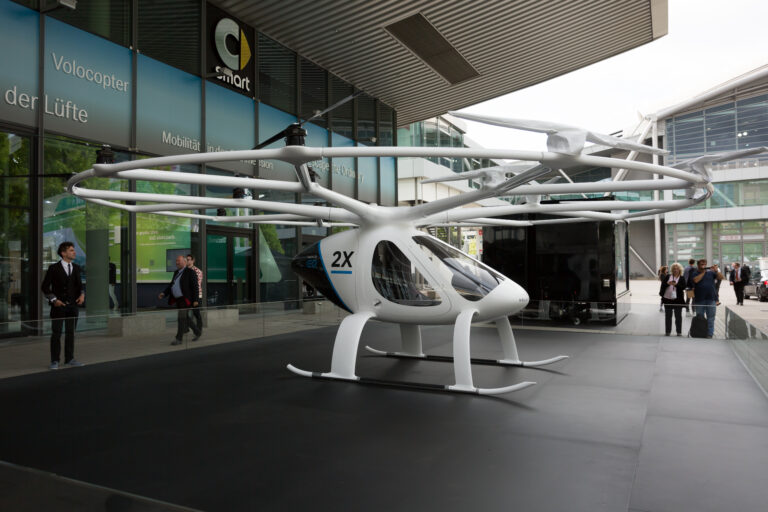
Drones comprise a sizable portion of the AAM phenomenon. Package-delivery from above is already authorized for a number of companies in several cities across the nation. But advancements in fields such as automation and battery storage are pushing safe, affordable, passenger-carrying electric vertical take-off and landing (eVTOL) aircraft closer to viability.
As Scientific American explained, with “multiple small propellers that spin half as fast as a chopper’s rotor,” the “pounding, 90-decibel ‘thwop, thwop, thwop’” that plagues helicopter travel isn’t an issue. Range is constrained, of course, as eVTOL won’t take you from San Diego to Boston in a single hop anytime soon. But several companies are confident that their vehicles are perfect for flying taxis. In California alone:
- Wisk Aero, headquartered in the Bay Area and backed by Boeing, is developing “the world’s first self-flying, all-electric, four-seat eVTOL air taxi.” The LLC’s “Gen 6 Aircraft” has a cruising speed of 138 miles per hour and its charging time is a mere 15 minutes.
- San Jose’s Archer Aviation boasts that the “unique design expression” of its Midnight vehicle “embodies numerous distinctive features that are harmoniously integrated to form an aircraft that is the first of its kind.” It recently closed a $126 million deal to “acquire control of a one-of-a-kind Los Angeles asset, Hawthorne Airport,” which will “serve as its operational hub for its planned L.A. air taxi network operations, including serving a key role in the LA28 Olympic & Paralympic Games.”
- Joby Aviation, which went public in 2021, is “developing a world-class manufacturing facility in Marina (California)” and has “offices and workshops in Santa Cruz, San Carlos, Washington, D.C., and Munich, Germany.” In November, it announced the inaugural flight of a “turbine electric, autonomous VTOL aircraft,” which “builds on Joby’s fully-electric air taxi platform and integrates a hybrid turbine powertrain along with the Company’s … autonomy stack to deliver greater range and payload capability.”
As momentum mounts for flying taxis, savvy cities will embrace several foundational principles to understand what’s going on — and avoid lurking hazards.
First, know your limitations. When it comes to flying at any altitude, the federal footprint is massive. The FAA regulates the manufacture, operation and maintenance of aircraft. In addition, the bureaucracy certifies pilots and provides air-traffic control to the “29 million square miles that make up the U.S. national airspace system.”
D.C.’s role is so vast that local governments in most cases are barred from controlling when aircraft can fly. Citing the Airport Noise and Capacity Act, in October, a judge tossed out a lawsuit filed by residents near a small Southern California airport. Per the Long Beach Post, the homeowners couldn’t bear the “constant late-night nuisance” imposed by a flight school’s numerous training sorties. But the Supremacy Clause proved to be an insurmountable obstacle to their resistance. The bottom line: Don’t step on the FAA’s toes.
Second, skip the subsidies. From high-speed rail to hyperloops, Segways and spaceports, transportation “revolutions” have a pesky habit of fizzling out — and leaving investors and taxpayers with lighter wallets. Even if flying taxis become ubiquitous, who’s to say which companies will soar and which will sputter?
Already, several efforts that appeared promising have stalled. In 2022, Palo Alto-based Kittyhawk, a startup supported by Google co-founder Larry Page, folded. Last winter, Germany’s Lilium went bankrupt for the second time. And in September, TechCrunch reported that Hyundai’s Supernal division, which has two facilities in California, “paused work on its aircraft program after a rocky few months that saw staff cuts and the departure of its CEO and CTO.”
“Economic development” administered by politicians and bureaucrats is seldom advisable, but at this stage, devoting tax revenue to AAM flirts with outrageous folly. So it’s best to eschew the example of state and local corporate-welfare supporters in Georgia. Three years ago, Archer Aviation secured $40 million in freebies to build a “state-of-the-art electric vertical takeoff and landing aircraft … manufacturing facility located alongside the Covington Municipal Airport in Newton County.” Time will tell if the “public investment” pays off.
Finally, restrain the planners. Despite their many costly boondoggles, the men and women paid to micromanage urban life remain immune to any form of humility. So it’s hardly surprising that their relentless policy entrepreneurship has targeted AAM. Last year, the American Planning Association (APA) partnered with the Mineta Transportation Institute to publish “Planning for Advanced Air Mobility.” The 98-page document contains dozens of red flags that threaten to thwart an organic, market-oriented rollout of AAM.
Think transit-oriented development is problematic? Wait until the spigots are opened for vertiport-oriented development. But VOD is only one tactic for manifesting APA’s vision of “social equity.” The association’s proposed toolbox includes the creation of government “training and retraining programs that provide the job skills and technical expertise to enter AAM career fields.” It calls for usage of “the STEPS framework” to “categorize an array of transportation equity barriers facing transportation users,” and a focus on the goal that “no group of people … disproportionately bear the negative environmental impacts of AAM operations or policies, especially vulnerable groups that are protected under Title VI of the Civil Rights Act and federal environmental justice initiatives.”
Flying taxis have immense potential and pose many pitfalls. Cities have a lot to learn about what should and shouldn’t be done about the coming of eVTOL transport. With the industry’s technological progress advancing rapidly, it’s not too early to start the lessons.