


Consider RIPA, the Racial and Identity Profiling Board.
In 2024, 533 agencies reported 5,065,428 encounters featuring 75 data points ranging from why encounters begin, whether they result from calls for service, what officers do, whether they search someone and what happens afterward. In all, 405 million pieces of information are analyzed by the Boards statisticians.
Yet the RIPA Board repeatedly returns to a remarkably simple comparison: people perceived as Black were stopped 127.87 percent more often than expected based on population, declaring these disparities to be “the result of racial and identity profiling.”
But population doesn’t tell us who called 911, who matched a suspect description, who had a warrant or where crime occurred.
A disparity should prompt inquiry. Too often, it ends it.
These are the numbers and circumstances against which California’s debate over race and policing should be understood. Instead, particularly since George Floyd’s death in 2020, some of the rarest and most disturbing encounters and one defining statistic have been allowed to define the whole conversation.
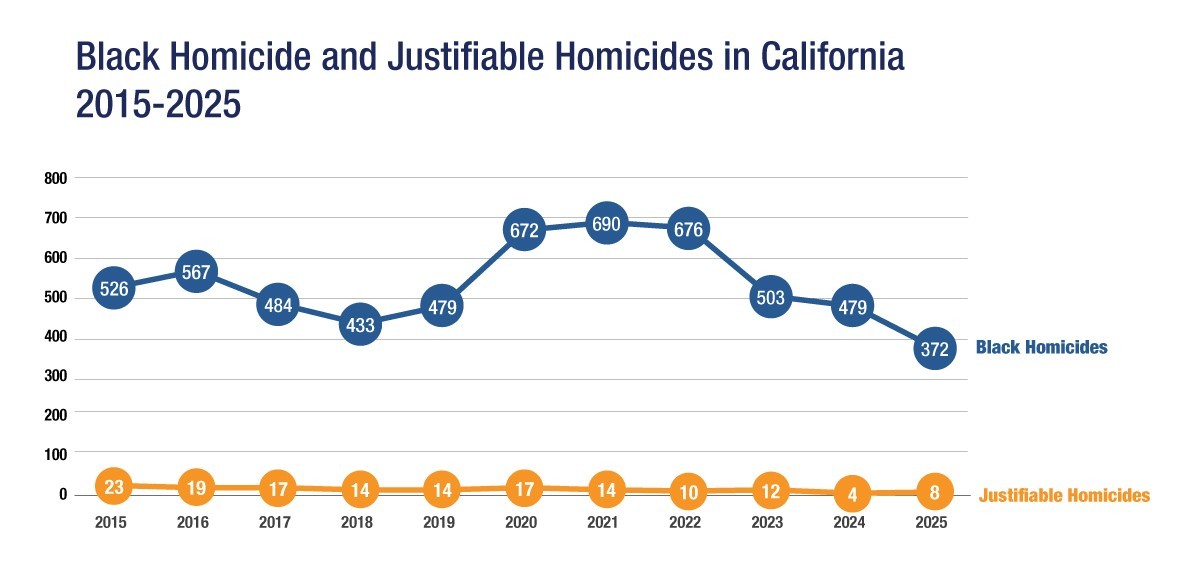
Let’s look at the state immediately before Floyd. In 2019, homicide rates had fallen to 1,679 from its 1993 peak of 4,095 and of those 479 Black Californians were murdered at the same time 14 died in justifiable homicides involving peace officers.
California was hardly ignoring police conduct. It passed the Racial and Identity Profiling Act in 2015, tightened its deadly-force standard, expanded police transparency, and begun collecting millions of police encounters by race.
Then perception overtook perspective.
“Defund the police” became a national movement. Los Angeles cut police funding. Departments curtailed some discretionary activity. Prosecutors changed practices. School districts removed officers.
Police contact itself increasingly came to be treated as a harm to be reduced.
The media helped define the moment. Newspapers and broadcasters devoted enormous attention to police shootings, racial disparities, pretextual stops and “over-policing.”
Then the numbers changed and for the worse.
California’s 1,679 homicides in 2019 grew to 2,361 in 2021. Black homicide victims went from 479 to 690. Another 676 were murdered in 2022.
At the same time, police activity fell dramatically. At California’s largest agencies, reported stops remained about one million below their pre-pandemic level even in 2023. COVID and enormous social disruption were certainly a factor, but it was also deliberately changing policing. Those developments deserve to be considered together.
The consequences weren’t confined to statistics. One relatively unknown case illustrates the consequences.
In July 2020, the Pajaro Valley Unified School District voted 5-2 to eliminate school resource officers during the post-Floyd reassessment of policing. Thirteen months later, 17-year-old Gerardo Sarabia was stabbed to death in the District at Aptos High School. This is a school that had never seen a homicide in a community that rarely does.
Police presence carries costs. Police absence carries risks too.
Within weeks, the school board voted 6–1 to bring officers back.
California’s homicide trajectory eventually reversed. Black homicide victims fell from 690 in 2021 to 372 in 2025. 318 fewer people were murdered in a single year as the post-Floyd fever began to break. Police returned to more active enforcement, cities began reclaiming public spaces, technology made it harder for violent and prolific offenders to remain anonymous, and voters increasingly rejected the idea that less enforcement was necessarily progress. Proposition 36’s overwhelming passage in 2024 didn’t start that change; but it reflected it.
If racial disparities matter, the remarkable decline in Black homicide victimization should rank among California’s most important racial-equity developments of the decade. Yet it receives nothing resembling the attention devoted to disparities in police stops.
Now put RIPA beside California’s police use of force data.
In 2024, RIPA recorded 612,443 encounters involving Black Californians, 1,584,354 involving Whites and 2,193,617 involving Hispanics. That year, California’s serious-use-of-force system recorded 11 Black civilian deaths, 41 White deaths and 58 Hispanic deaths. California’s Homicide in 2024 reports lists 4 as “justifiable” and 7 remain under investigation by the Attorney General.
Relative to reported encounters, that’s 1.80 deaths per 100,000 Black encounters, 2.59 for Whites and 2.64 for Hispanics. The fatal-outcome rate was 44 percent higher for Whites than Blacks and 47 percent higher for Hispanics.
The racial disparity didn’t just disappear. It changed course 180 degrees. Let me repeat that. Of California’s three largest racial and ethnic groups, Black Californians had the lowest fatal-outcome rate relative to reported police encounters.
Why isn’t that part of California’s racial-profiling discussion? It doesn’t prove profiling doesn’t exist or excuse an unjustified use of force. It demonstrates that California’s own data tell a far more complicated story than its headline racial comparison.
Now consider the people on the other side of policing. Black Californians accounted for 372 of California’s 1,374 homicide victims in 2025—27 percent.
Victimization generates policing. A shooting generates a 911 call. A robbery produces a suspect description. A murder produces witnesses, searches and warrants. Police looking for the person who shot a Black teenager can generate additional Black police encounters that later appear in RIPA’s disparity tables.
Counting the encounters without fully accounting for why they occurred means protecting communities itself can look like discrimination.
The problem isn’t RIPA’s data. The problem is reaching conclusions without using enough of it.
The same problem distorted the broader post-Floyd debate. Like the Mad Hatter’s tea party, navigating the reciprocal course set by the incomplete data analysis means down is up and up is now down.
Police killings, and killings are clearly the exception, became representative of ordinary policing. Racial disparity has become evidence of racism. Fewer police encounters became progress, and the protective function of policing slipped from view.
California now possesses the information necessary to tell a more complete story: RIPA encounters, DOJ homicides and justifiable homicides, serious uses of force, crime victims, calls for service, stop reasons and outcomes.
The problem isn’t a shortage of data. It’s the data we chose to see and the story we choose to tell with it.
California has spent years examining equity in enforcement. Keep examining it. But put the crime victim back into the picture and ask the equally important question: Are Californians receiving equity in protection?
Because racial equity in criminal justice cannot simply mean reducing the number of times Black Californians encounter police. It must also mean reducing the number of times they encounter murderers.
Steve Smith is a senior fellow in urban studies at the Pacific Research Institute, focusing on California’s growing crime challenges.