


California Campus Data
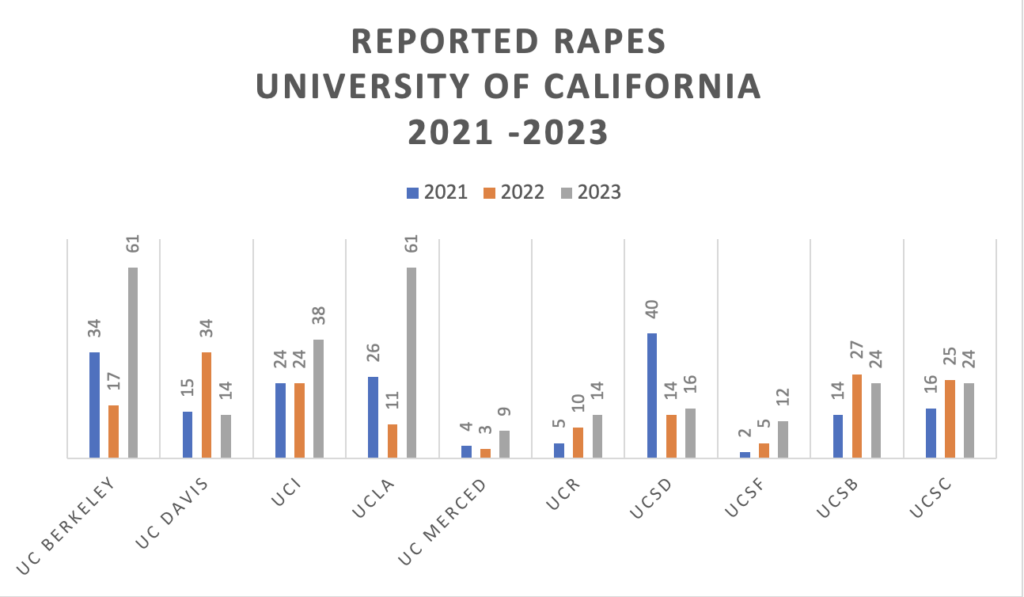
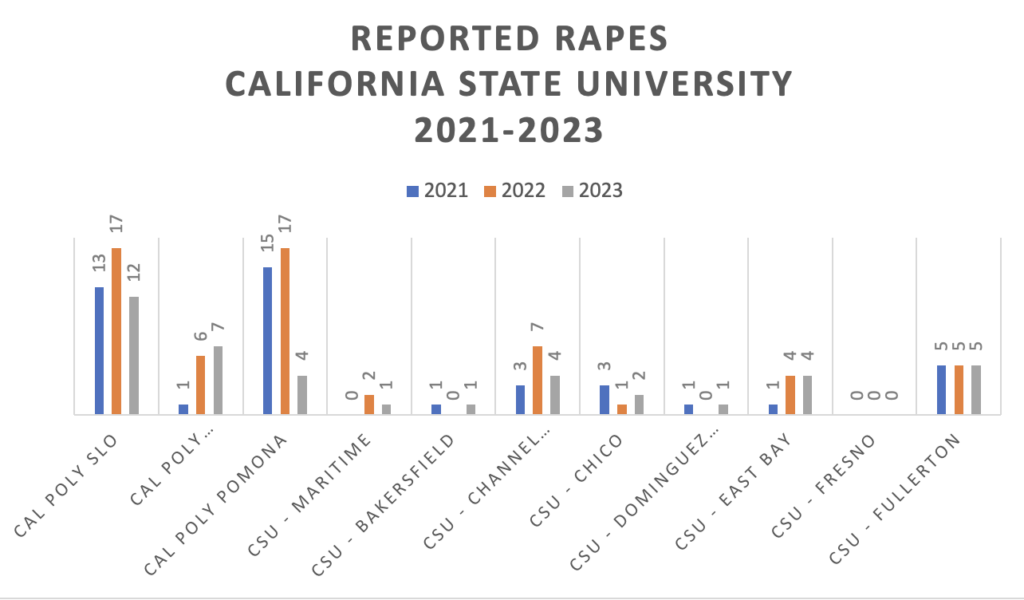
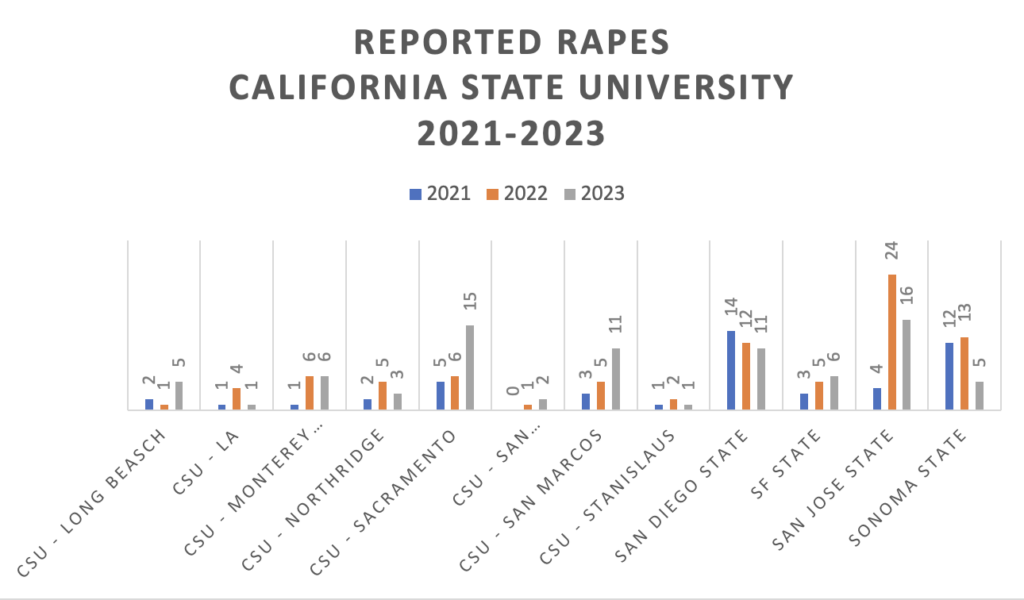
Clery data from California’s largest universities illustrate the scale of the issue:
- UC Berkeley and UCLA each reported 61 rapes in 2023. When adjusted for student population, this equates to rates of 184.5 per 100,000 students at UC Berkeley and 164 per 100,000 at UCLA—approximately four to six times the statewide reported rate.
- Applying conservative underreporting estimates to UC Berkeley’s enrollment suggests that as many as 5,500 students annually—approximately 4,500 women and 1,000 men—may experience sexual victimization.
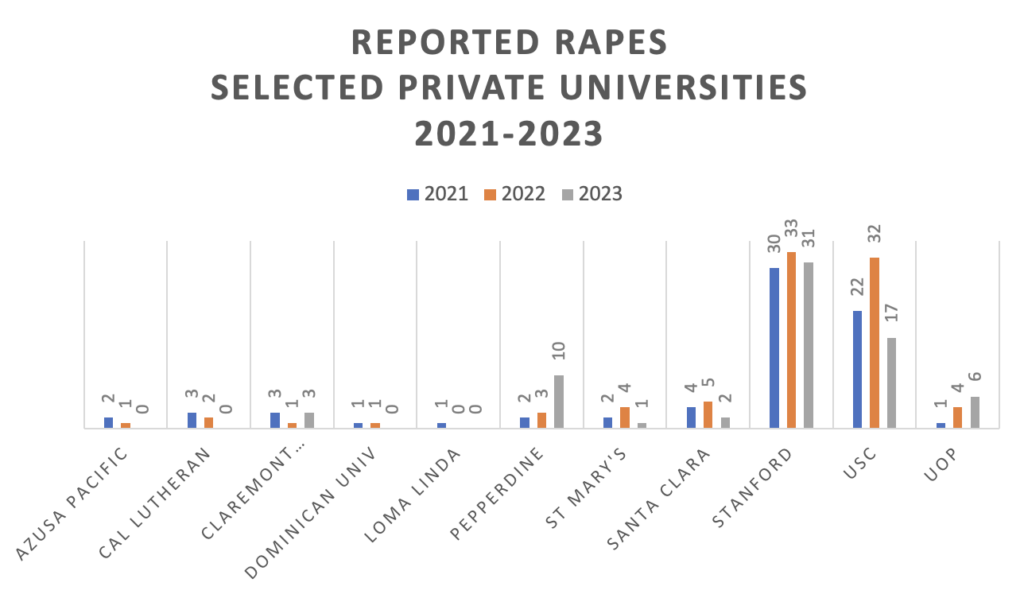
- Stanford University reported a rate of 167 per 100,000, while USC reported 80 per 100,000.
These elevated rates occur across both public and private institutions, indicating a systemic issue rather than an isolated institutional failure.
Campus Housing and Risk Concentration
Clery data also reveal a strong correlation between sexual assault and on-campus housing. At many institutions, the majority—and in some cases all—reported rapes occurred in residence halls or university-managed apartments:
- Cal Poly San Luis Obispo: 12 of 12
- CSU Fullerton: 5 of 5
- UC Santa Barbara: 20 of 24
- UC Santa Cruz: 21 of 24
- UC Davis: 11 of 14
When assault rates are recalculated based solely on the population residing in campus housing, effective rates often exceed 150 per 100,000 residents, dramatically higher than general crime benchmarks.
Data Gaps and Transparency Concerns
Several major universities report substantial numbers of sexual assaults with undisclosed or unclear locations:
- At UCLA, 35 of 61 reported rapes lack a specified location.
- At UC Berkeley, 41 of 61 are similarly unaccounted for.
- At Stanford, 18 of 31 reported rapes are not assigned a location category.
In contrast, institutions such as USC, Pepperdine University, and the University of the Pacific report complete location data. These inconsistencies raise concerns about reporting practices, data transparency, and the ability of policymakers to assess risk accurately.
Structural Contributors to Campus Sexual Assault
Multiple structural factors contribute to elevated sexual assault risk on college campuses:
- Age-related risk behaviors, including higher rates of alcohol and drug use in unlicensed settings that increase vulnerability to victimization.
- Campus housing oversight often relies on student resident assistants with limited training and largely reactive enforcement models.
- Campus police departments may be understaffed, insufficiently trained in sexual violence prevention and investigations, or focused on lower-level quality-of-life issues.
- Open-access campus designs, particularly at public universities, permit broad public entry into residential and recreational spaces.
- Underreporting remains pervasive due to fear of retaliation, stigma, or lack of confidence in institutional response.
Fiscal Priorities and Public Responsibility
While maintaining low tuition remains a central political priority in California, campus housing, dining, recreation, and event facilities often function as revenue-generating enterprises producing millions of dollars annually. Stanford University is fully residential as is CSU Maritime (now Cal Poly Maritime) and Sacramento State will mandate that all single first and second year students live on campus beginning in Fall 2026.
In this context, questions arise regarding whether student safety—particularly in high-risk residential settings—has received commensurate investment and oversight.
Policy Implications
Sexual assault on college campuses is not merely a student conduct issue; it is a public safety, governance, and accountability issue. The concentration of assaults in campus housing, inconsistencies in reporting, and persistently high victimization rates suggest the need for legislative and regulatory attention.
Potential policy responses may include:
- Enhanced Clery Act compliance audits and standardized location reporting
- Minimum training and staffing standards for resident assistants and campus police
- Required public disclosure of housing-specific assault rates
- Dedicated funding for prevention, supervision, and victim support services
- Independent oversight mechanisms for campus safety practices
- Increasing penalties for the possession and use of intoxicants to facilitate sexual assault
The scale of victimization documented in Clery data warrants a reassessment of how California’s colleges and universities balance revenue generation, access, and student safety—and whether current oversight mechanisms adequately protect the students they serve.
Steve Smith is a senior fellow in urban studies at the Pacific Research Institute, focusing on California’s growing challenges.