
Stock Market Volatility Is a Growing Threat to California’s Upcoming Budget
Wayne Winegarden
March 2026
Warren Buffett famously noted that “when the tide goes out, you discover who’s been swimming naked.” Heeding Buffet’s wisdom, we will soon discover whether Governor Newsom and state legislative leaders are in need of some swimwear.
California’s personal income tax system is excessively progressive. The top 1 percent of income tax filers typically fund between 40 percent and 50 percent of total income tax revenues. And true to form, the explosive growth in the stock prices of Artificial Intelligence companies like Nvidia has been a boon for California’s income tax revenues.
Tracking the state’s monthly personal income tax revenues, the Legislative Analyst’s Office (LAO) notes that the year-over-year growth had been around 10 percent but the rate of growth “has decelerated to roughly 7 percent in January and February.” The latest “3-month total withholding for December, January, and February is up just 3.3 percent from the same period one year earlier.”
The LAO’s assessment provides an important warning to state leaders. Fears are growing that, regardless of its ultimate potential, the appreciation of AI stocks has been excessive. Should these stocks be overvalued, then there will be a reckoning for income tax revenues. Layering on the economic uncertainty created by the Iran conflict, and its impact on the stock market, the risk that California’s personal income tax revenues will underperform expectations is growing.
A weakening stock market is a growing risk to the state budget
California’s over-reliance on positive stock market performance is not a new phenomenon. The chart below compares, on a monthly basis, California’s annual growth in income tax collections as documented by the LAO to the percentage change in the NASDAQ. There is traditionally a delay between the performance of the NASDAQ and the resulting impact on state income tax revenues – both positively and negatively. Since 2020, this delay appears to be around 10-months.
Accounting for the 10-month lag, the chart shows that growth in the state’s personal income tax revenues closely follows the performance of the NASDAQ. In fact, the strong performance of the tech-heavy NASDAQ has helped California’s personal income tax revenues to exceed expectations for the current fiscal year. But as the old adage goes, “past performance is not indicative of future results.”
KEY TAKEAWAYS
- California’s budget depends on a growing stock market. The robust market through early 2026 produced positive revenue surprise for the current fiscal year but the current stock market volatility is a growing risk for next year’s budget.
- A stock market decline similar to 2022 could cause the expected budget hole to increase by an additional $2 billion (the Governor is forecasting a $3 billion budget hole, the LAO is forecasting a larger $18 billion deficit). A larger stock market decline could increase the shortfall by $6 billion.
- Without spending discipline, balancing the budget using tax increases will create additional economic losses. Relative to the baseline, these tax increases could shrink. California’s economy by up to 2.8 percent, reduce the average household’s income by up to $1,400, reduce the growth in jobs by up to189,000, and increase the exodus of people from the state by up to 197,000.
California’s Personal Income Tax Revenues Follows The NASDAQ’s Performance
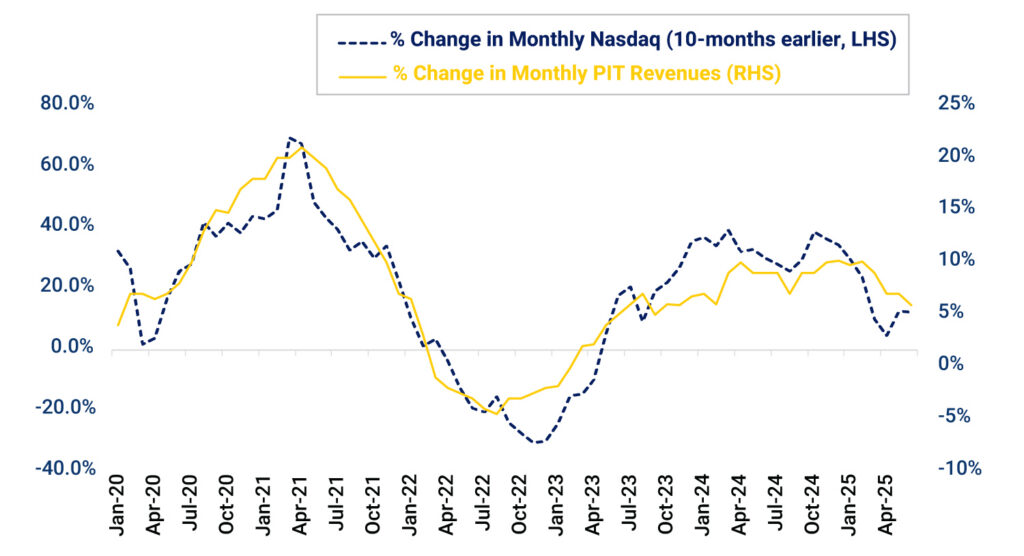
As the LAO has warned, the growth in income tax revenues has slowed in the three months to February. Not surprisingly, the prices for the largest stocks in the NASDAQ are down around 4.5 percent as of March 10th compared to their January 28th peak. With risks mounting, a sharper downturn in the stock market is a growing risk that California ignores at its peril.
Should the NASDAQ be entering a downturn that is similar to its 2022 decline, and accounting for the 10-month lag, state personal income tax revenues for the upcoming fiscal year could be around $2 billion short of expectations. This shortfall would increase Newsom’s estimated budget hole to $5 billion, not the $3 billion he reported in the January budget. A major stock correction would widen the budget hole to $9 billion. If the major stock correction is coupled with the LAO’s more pessimistic expectations, California has a potential $24 billion budget hole that must be addressed. Such large deficits warrant extreme caution.
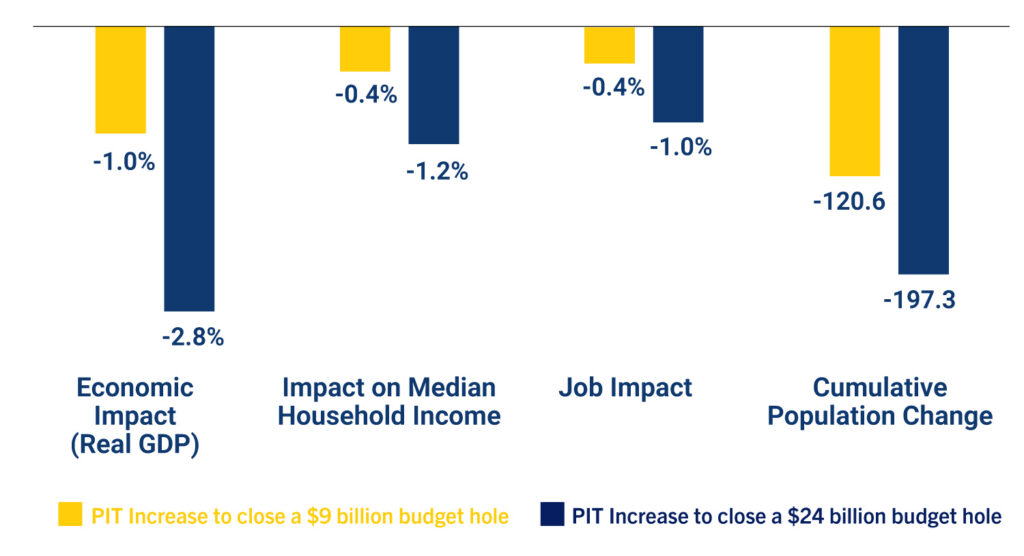
To get a sense of what’s at stake, if a major stock correction occurs and the state’s policy leaders do not cut spending or implement other budget management policies, then taxes would need to increase between $9 billion and $24 billion, depending on the actual size of the deficit.
Based on PRI’s economic and tax model, and assuming the taxes are raised through increasing the personal income tax rates, we estimate that, within five years, the size of California’s economy could shrink between 1.0 percent and 2.8 percent relative to the baseline. Further, the growth in the average household’s income would be between $530 and $1,400 smaller, the growth in jobs would be between 70,500 and 189,000 less, and the exodus of people from the state would increase between 121,000 and 197,000.
5-Year Economic Impact Compared to Baseline
(population change in thousands)
Conclusion
As Niels Bohr famously noted, “prediction is very difficult, especially if it’s about the future.” Such humility clearly applies to predictions about California’s upcoming budget health. Due to the growing uncertainties surrounding California’s future tax revenues, and the large economic losses that would result from using taxes to close the budget hole, Governor Newsom should be repeating one simple mantra as he develops his May Revise – budget austerity.