
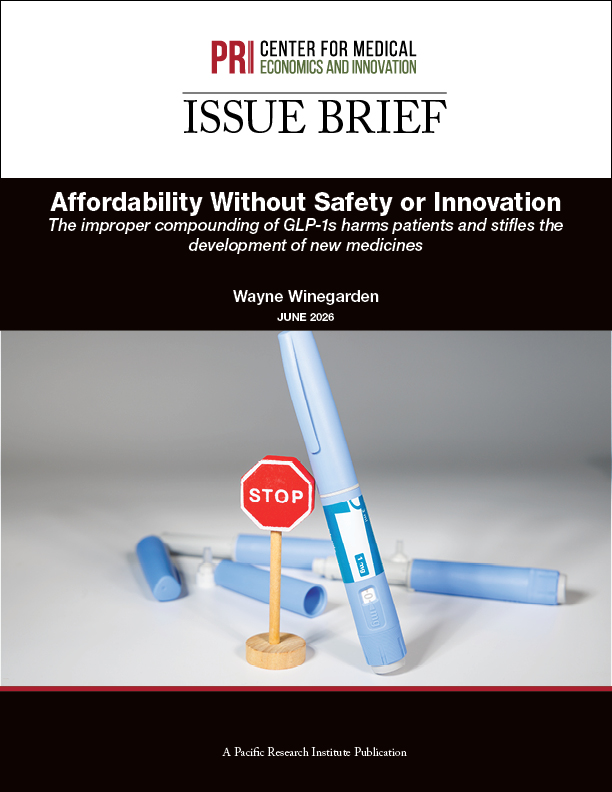
As federal regulators intensify enforcement against companies selling unauthorized knockoffs of blockbuster weight-loss drugs, a new Pacific Research Institute brief warns that the booming GLP-1 knockoff market is creating patient safety risks while undermining future breakthrough medicines.
“GLP-1s are among the most promising medical breakthroughs in decades, helping patients struggling with diabetes, obesity and other chronic illnesses,” said Dr. Wayne Winegarden, director of PRI’s Center for Medical Economics and Innovation and the brief’s author. “But allowing unauthorized manufacturers to mass market GLP-1 knockoffs outside FDA safeguards creates significant patient safety risks and undermines trust in the healthcare system.”
GLP-1 medicines such as semaglutide—marketed as Ozempic and Wegovy—and tirzepatide—sold as Mounjaro and Zepbound—have become among the most widely used diabetes and weight loss treatments. Independent estimates cited in the study show that between 8 and 10 percent of U.S. adults are taking GLP-1 medications, or upwards of 34 million Americans.
The brief examines the rapid growth in marketing of compounded versions of GLP-1 drugs following FDA-declared shortages that began in 2022. Compounded drugs can meet an individual patient’s needs when FDA-approved drugs aren’t suitable or available. Compounded drugs are not FDA-approved, so their safety or effectiveness is not verified before patient use. Although the shortages ended in 2025, many compounders continue marketing the unauthorized knockoffs.
The FDA has expressed many concerns with these knockoffs including improper storage, dosing errors, questionable sourcing of active pharmaceutical ingredients, and misleading advertising practices. It has linked compounded semaglutide and tirzepatide to hundreds of adverse health events, including hospitalizations and deaths. The experimental weight loss drug Reatrutide is being marketed even before the FDA review and approval process has completed.
Federal regulators have begun stepping up enforcement efforts. In February 2026, the FDA announced it was restricting GLP-1 active pharmaceutical ingredients from being used in unapproved compounded drugs. It sent warning letters to 30 telehealth companies over what it described as illegal sales and misleading marketing of GLP-1 knockoffs. Recently, the U.S. Department of Health and Human Services referred telehealth company Hims & Hers to the U.S. Department of Justice to investigate potential violations of federal drug law.
The study also argues that GLP-1 knockoffs threaten the financial incentives necessary to develop future innovative medicines. According to the paper, innovative drug manufacturers reinvest roughly one-third of their revenues into research and development. The brief estimates that unauthorized GLP-1 compounding could reduce future pharmaceutical R&D investment by between $9.3 billion and $11.8 billion, potentially resulting in four to five fewer new medicines being developed.
“Patients deserve affordable access to innovative medicines, but the answer is not eroding patent protections or tolerating large-scale unauthorized GLP-1 knockoffs,” Winegarden added. “The solution is enacting healthcare payment reform empowering patients, increasing competition, lowering costs, and preserving the incentives to develop the next generation of cures.