

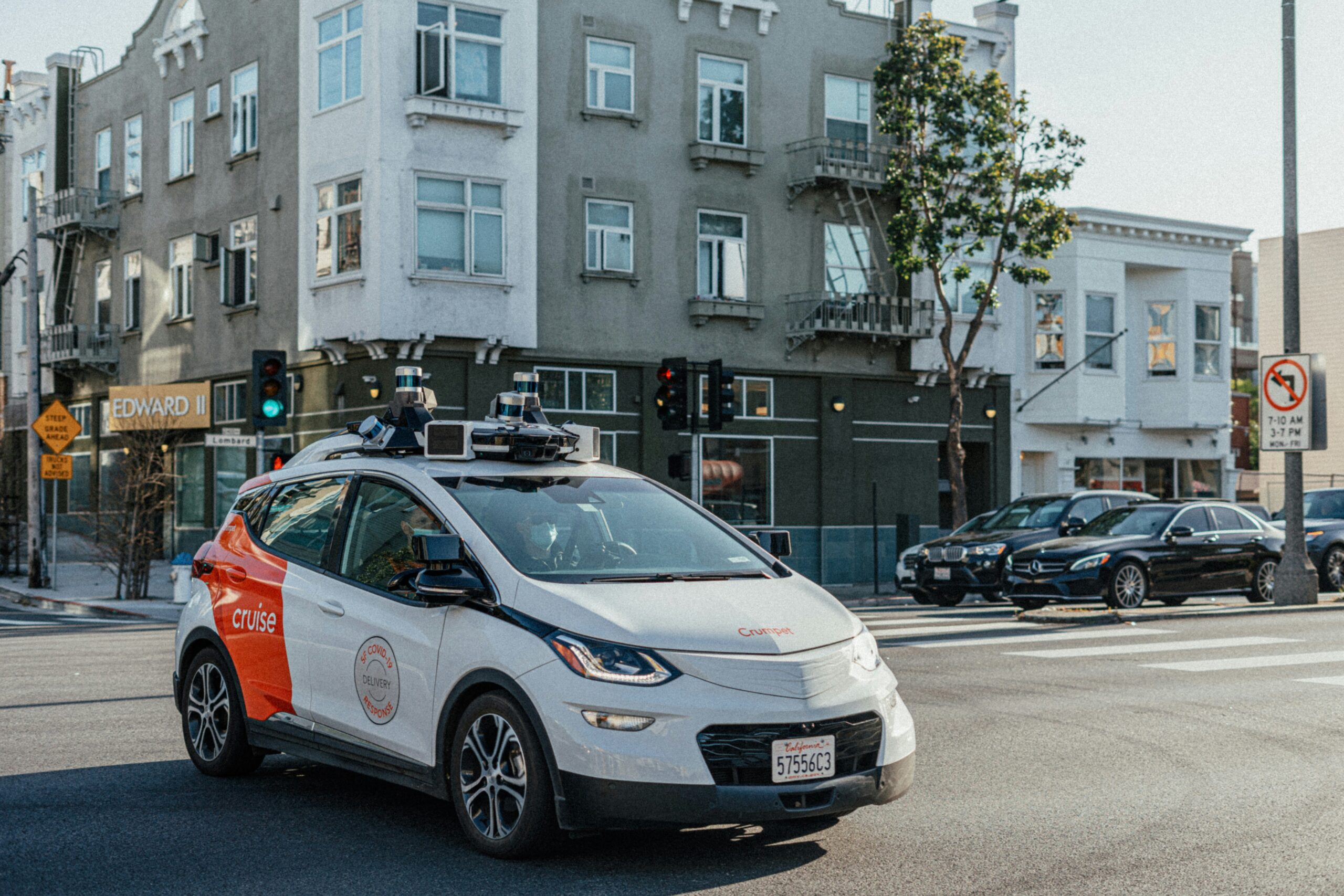
Waymo is the Autonomous Vehicle division of Alphabet/Google, which for two decades has mapped almost every road in America. The cars are electric I-Pace Jaguars made in Austria by Magna Steyr and, he said, quite luxurious.
Other cities hosting Waymos include Los Angeles, Austin, Atlanta and San Francisco, also covering parts of Silicon Valley, such as San Jose and Mountain View, Waymo’s headquarters. Next arrive Miami, then Washington, D.C. California just approved Waymo’s expansion into more areas of Northern and Southern California.
In June, Elon Musk launched his robotaxi in Austin, albeit so far with a “human safety operator” riding shotgun, just in case. They were modified Teslas, of course. But Musk’s long-term plans include the Cybercab, specially designed as an AV and unveiled in Oct. 2024.
Wikipedia includes a list of wild Musk predictions of AV adoption. “We should be able to do 90% of miles driven [autonomously] within three years,” he said in 2013. Although entrepreneurs have a tendency to overpromise, AVs are coming down the pike – fast. In June, EV Magazine listed eight other AV companies: Toyota, BMW, Mercedes Benz, Mobileye Global, Amazon, VW, GM, NVIDIA, Amazon and Intel. The latter three are leaders in Artificial Intelligence, meaning they literally have hundreds of billions of dollars they can invest.
Cities need to get ready for this innovation and the inevitable changes in traffic patterns. Best practices should include encouraging AV adoption, while addressing safety and privacy concerns. The main thing is city councils and county boards need to start planning.
A good example is Los Angeles, where in June 2024 the City Council reviewed AV reports from Los Angeles World Airports, the city Department of Transportation and the Los Angeles Fire Department. Reported NBC 4 Los Angeles, the council “voted 13-0 to approve the backing of three state bills aimed at providing municipalities more power to regulate autonomous vehicles and gain access to testing data.”
Computerized driving should make traffic move more quickly and safely. Fewer drivers will be changing lanes while applying makeup with one hand and talking on an iPhone with the other. But cars will become office extensions, making long commutes less arduous and more common. People will sit in back seats, working on laptops or taking naps.
“The effects are uncertain because they depend on automated driving system performance, market penetration of various use cases,” Marc Scribner told me; he’s a senior transportation policy analyst at the Los Angeles-based Reason Foundation. The use cases “will ultimately be driven by service price compared to alternatives, substitution for other modes of transport, trip generation and traffic management policies, including road and curb pricing. Each of which would require a lot of speculation to model.”
He said Waymo’s early performance has shown “a strong potential to reduce non-recurring congestion arising from crashes.” Some people are concerned about vehicle miles traveled and problems with traffic flow. But those concerns assume traffic management won’t adapt. “I don’t think that’s a particularly realistic assumption,” he said.
A 2019 study in Transport Reviews is titled, “Impacts of automated vehicles on travel behavior and land use: an international review of modeling studies.” Based on global patterns, it found: “AVs are mostly found to increase vehicle miles traveled and reduce public transport and slow modes share,” meaning vehicles going less than 25 mph. “This particularly applies to private AVs, which are also leading to a more dispersed urban growth pattern.”
A big impact could be shared vehicle fleets, “including reducing the overall number of vehicles and parking spaces.” However, the study cautioned it’s too early to make many conclusions.
A July 2025 study was published in Transportation Research Interdisciplinary Perspectives, “Evaluating urban network efficiency and safety impacts of connected and autonomous vehicles in complex city environments.” It looked at a five square mile section of San Jose, with 300-plus intersections. Results:
- With 30% AV penetration, “stop delays decreased by up to 11%, with total delays down by 7%.”
- “Crossing conflicts,” which can lead to actual crashes, were reduced “by up to 10%, though rear-end and lane-change conflicts increased.”
- Increased urban “platooning,” where vehicles are electronically coupled to move cohesively as a unified stream, “showed limited delay benefits, possibly due to frequent intersections in complex urban layouts.”
- Results provide data-driven guidance for safe, efficient AV deployment in cities.
Then there’s cost. Anecdotal evidence indicates AVs so far may cost more than Uber and Lyft. On October 6, Alex Bitter of Business Insider wrote of his experience in San Francisco, where AVs are “everywhere.” A 12-minute Waymo ride ran $16. “Despite not having a human driver to pay, Waymo charged me more than Uber or Lyft would have for the same trip.” But prices could go down as the technology becomes more efficient.
Other factors include not having to worry about the safety of being in the car with a driver. And whether one is OK riding in a car not run by a human. A couple friends I asked said, “No way am I getting in a car without a real person driving.”
Maybe they saw the 1990 Arnold Schwarzenegger flick “Total Recall.” In 2084 on Mars, a robotaxi called a Johnnycab, “driven” by a mannequin, refuses to take off during a chase. Arnold rips out the mannequin and drives himself. After escaping, he leaves the car, which then tries to kill him and crashes. Before blowing up, Johnnycab quips, “We hope you enjoyed the ride.”
Yet the data from Swiss Re, a major reinsurance company, shows that Waymo taxis have 90% fewer claims than human drivers. The sooner people get used to riding without a driver, the sooner our cities might have fewer traffic jams.
John Seiler is on the Editorial Board of the Southern California News Group.