


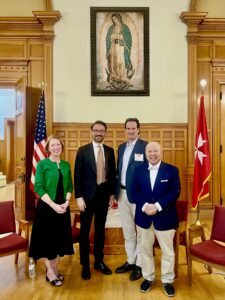
Recently, I had the pleasure of moderating a panel on alternative Catholic education models at a retreat conference for the Order of Malta, which is a lay order of the Catholic Church founded a millennium ago and which focuses on medical, social, and humanitarian aid projects. The panel gave insight into the reasons for the increasing popularity of education options outside of the regular parochial school systems.
 Catholic schools operating under the regular parochial system are often associated with individual parishes and are administered by the local diocese/archdiocese, which is headed by a bishop/archbishop. The Diocese of Sacramento, for instance, administers 36 elementary schools and six high schools.
There are Catholic schools, however, that operate independently of diocesan or archdiocesan control.
For example, one panelist at the Order of Malta conference, Conor Heaton, vice president of the Cristo Rey network of high schools, discussed the growth in the number of schools in the network and why parents and their children are drawn to Cristo Rey schools that are independent of diocesan/archdiocesan administration.
Cristo Rey schools are the only network of high schools in the nation that integrate four years of rigorous academics with professional work experience through its Corporate Work Study Program, which places students, who are from low-income families, in entry-level professional jobs through their entire high school experience.
Every Cristo Rey school has at least 30 corporate sponsors ranging from law firms to banks to hospitals, which employ the school’s students. Unlike the typical parochial school, Cristo Rey students get real-world workplace experience that changes their view of what is possible in their lives.
As Cristo Rey notes, their educational model “strengthens students’ competence, confidence, and aspirations to empower them to build fulfilling lives.”
With the skills and knowledge that they pick up during their school and employment experience, it is no surprise that graduates of Cristo Rey complete college at more than twice the rate of the U.S. low-income population.
No wonder then, as Heaton pointed out, that Cristo Rey has grown from a single school in Chicago in the mid-1990s to 41 schools today, covering 24 states and serving 13,000 students.
The Chesterton Schools Network has a much different education model than Cristo Rey but is experiencing similar growth.
An initiative of the Society of Gilbert Keith Chesterton, a Catholic non-profit named after the famed Catholic writer, the Chesterton academies use a classical education model, which is often not used in regular parochial schools and which centers on reading, writing, oral presentations, and the development of critical reasoning skills through logic and philosophy.
Greg Billion, headmaster of the Chesterton Academy of St. James in Menlo Park, California and a panelist at the Order of Malta conference, noted that the classical model uses the trivium, which has three stages of learning.
Grammar, the first stage of learning in grades K-5, focuses on absorbing facts and building a strong foundation of basic knowledge and skills through, for instance, phonics-based reading instruction.
Logic, the second stage of the trivium in grades 6-8, focuses on the “why,” with students questioning and debating, and learning to analyze arguments and recognizing logical fallacies.
Finally, rhetoric, the third stage of the trivium in grades 9-12, focuses on expression, where students synthesize their knowledge and argue persuasively.
Further, Billion discussed his school’s incarnational environment, where students encounter Christ in all subjects from math to art. Chesterton’s classical curriculum combines a broad liberal arts education with a strong emphasis on Christian virtues such as charity and humility. Throughout their learning, students gain an appreciate for the beauty created by God.
As the Network says, its schools focus on “Truth, Goodness, and Beauty.”
The third panelist was Mary Sonne, a Catholic homeschooler. She described how homeschooling allowed her to tailor a Catholic education to the unique needs of her children.
She said that homeschooling offers many advantages, such as allowing more frequent field trips to places such as California’s famed Catholic missions.
Unlike the stereotype of homeschooled children being isolated from their peers, homeschool families interact in a variety of settings such as co-opts that bring homeschooled children together for group instruction and activities.
Families can also choose from a plethora of curriculum options. Sonne said that she would talk to her fellow homeschooling moms about the most effective curricula.
Catholic homeschooling, thus, gives Catholic parents the ability to control and individualize learning in a way that is impossible in a parochial brick-and-mortar school.
No wonder that Catholic homeschooling has surged with estimates of nearly half of million Catholic students being homeschooled.
At a recent dinner I attended at Kolbe Trinity School, a well-regarded independent Catholic school in Northern California, keynote speaker Stephanie Saroki de Garcia, co-founder of the Catholic nonprofit Seton Education Partners, said that school choice was expanding rapidly across the country while the old factory model of education was collapsing.
She pointed to the importance of alternative schooling models, such as the joyful and academically rigorous classical education model used at Kolbe Trinity School, which offers a different option for parents.
Afterwards, she explained to me how her nonprofit advances independent Catholic education: “In 2020, at the onset of COVID, Seton Education Partners launched our first independent Catholic school in Cincinnati’s Price Hill neighborhood. We opened in person, every day, for every child—made possible by our unique governance structure. We partner closely with pastors across our Catholic schools, supporting their ministry by taking on what we do best: operating a complex school organization so they are free to do what only they can do.”
Seton has established schools in New York, Ohio, and Texas, with enrollment growing at a 20 percent clip.
With the closure of 1,400 Catholic parochial schools over the last decade there is a need for reimagining Catholic education. The growth of the Cristo Rey schools, the Chesterton Academy schools, Seton schools, and Catholic homeschooling demonstrates that there is a market for innovative Catholic education that meets the demands of families. And with state and federal school choice programs increasing significantly, more families will have the opportunity to access these successful alternative Catholic education models in the years to come.
Lance Izumi is senior director of the Center for Education at the Pacific Research Institute.