

Newsom denied that the cost — once a paltry, in comparison, $33 billion — had soared to $231 billion.
“We’re actually making this project work,” he claimed.
Newsom told Maher that the train “goes back three administrations” and he “inherited a mess” — both of which are true. It’s also true that the want-to-be-president governor could have demonstrated the backbone of leadership and “let the train go” when doing so would have meant the sunk cost would have been far less than it is today, about $15 billion.
Instead, Newsom declined to make the right choice, and now Californians are looking at what more than a decade ago was considered the most expensive public-works project in U.S. history and will surely be the most expensive in world history if it’s not shut down.
That $231 billion estimate is more than two-thirds in today’s inflation-adjusted dollars (roughly $312 billion) of what was spent from 1956 to 1991 ($128.9 billion in 1991 dollars) to build an interstate freeway system across the country. It feels like an embellishment made by opponents who want to stop the train, because the most recent estimate had reached a whopping $126 billion, even though it’s pared-down version of the original plan. How could it have nearly doubled almost overnight?
The new figure “does not reflect” the High-Speed Rail Authority’s “published plan,” says the agency. The HSRA says the $231 billion “represents a high-end, unoptimized scenario based on legacy design and delivery assumptions that have since been reevaluated.”
The figure, however, did come from the HSRA’s 2026 Business Plan, which said the agency “used methods from bottom-up cost estimating to re-estimate the full Phase 1 buildout at approximately $231.3 billion in today’s dollars.” It distances itself from the higher cost through “$105 billion in program-wide savings” found by an “optimized approach” that “lowers threshold capital investment.”
The nonpartisan Legislative Analyst’s Office says the downsizing includes changing the locations of the stations in Bakersfield (to the “outskirts” of town) and Merced (to more than three miles south of downtown), making them more “modest,” and utilization of a single-track line for 144 of the 162 miles in Phase 1. When the HSR must share existing track rather than run on “dedicated high-speed rail tracks,” slower speeds will be required.
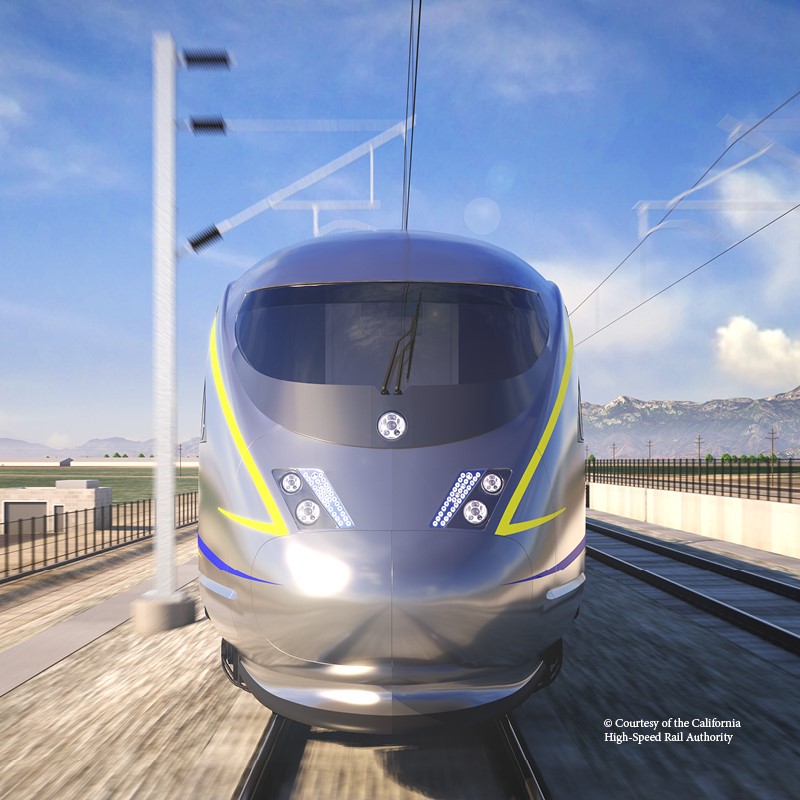
Californians were promised a modern system that would rip up and down the state at 220 mph, move passengers between Los Angeles and San Francisco in a brisk 150 minutes and cost a mere $33 billion. But the cost soared as the scope narrowed, and projected fares rose as expected ridership cratered. It will never be California’s version of Japan’s Shinkansen, nor the state’s answer to Europe’s impressive stable of bullet trains.
Maher is right — California needs to let go if its high-speed rail aspirations. It won’t happen, though, until a bold leader steps up.
Kerry Jackson is the William Clement Fellow in California Reform at the Pacific Research Institute and co-author of The California Left Coast Survivor’s Guide.
(Image credit: California High Speed Rail Authority)