
Cities still grappling with the fallout
17 months after LA’s wildfires
By John Seiler | June 19, 2026
Since the January 2025 wildfires devastated Pacific Palisades and Eaton, what have policymakers done to make sure California cities are better protected from future outbreaks? Policies should be split into “three buckets,” Kyle Greenspan told me; he’s a research associate with the Water Policy Center at the Public Policy Institute of California (PPIC). One bucket concerns “big landscape” problems, such as clearing highly flammable brush in forests. That’s basically a state and federal matter.
The second bucket concerns what can be done by local governments and utilities, or by the state to help or improve local conditions. “The main thing I would point to is ignition reduction, or just reducing the number of fires that start,” he said. “The main types of folks responsible for that are the utilities.” That’s because they operate the power lines that cause most of the fires that start from high winds.
Indeed, the U.S. Department of Justice last September sued Southern California Edison, as its statement explained, “alleging the company’s negligence caused the deadly Eaton and Fairview fires, which burned tens of thousands of acres of National Forest System lands, killed a total of 21 people, and destroyed thousands of buildings.” The Fairview fire burned Riverside County in 2022. The litigation is ongoing.
SCE’s May 2025 Wildfire Mitigation Plan Fact Sheet for 2026-28 outlined:
[A] clear path forward to enhance grid resilience and reduce wildfire risks. With approximately a quarter of the company’s service area at risk for potential wildfires, SCE is further hardening its infrastructure, bolstering situational awareness capabilities, enhancing operational practices and harnessing the power of data and technology to tackle and find solutions to those risks.
Efforts include better grid design and system hardening, inspections, vegetation management, “cutting-edge technologies” and “early fault detection expansion.” The full 730-page 2026-2028 Wildfire Mitigation Plan Revision 1 is worth a read.
The third bucket, Greenspan said, is “vegetation management.” He pointed to existing state and local laws requiring “defensible space zones” around homes in areas at risk for wildfires. A 2021 report by the Legislative Analyst’s Office detailed how “homeowners in certain areas at high risk of wildfires are required to create and maintain defensible space.” It provided a graph summarizing the laws.
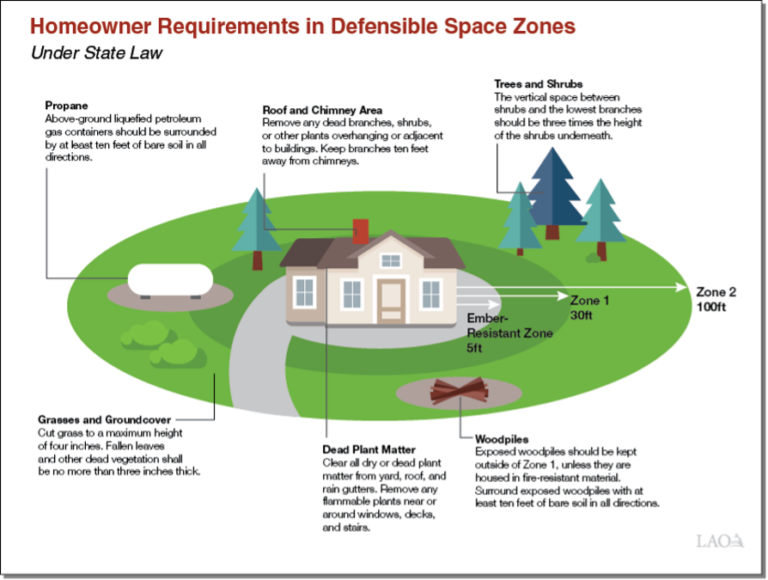
However, it also noted, “Many communities report relatively high compliance rates with defensible space regulations, but there is significant variation by location. Moreover, given the large number of homes in fire‑prone areas in California, even a moderately high compliance rate means that there are probably hundreds of thousands of homes out of compliance throughout the state.”
To advance compliance, last year Gov. Gavin Newsom signed an Executive Order directing the State Board of Forestry to accelerate “Zone 0” regulations requiring an “ember-resistant zone within five feet of structures located in the highest fire severity zones in the state.” The rules went into effect for new construction last February and will be implemented to existing homes beginning in 2027.
However, LAist reported that a complication has developed: People love the shade provided by the foliage both for aesthetic reasons, and because it protects them from extreme heat. Enforcement could be difficult given the costs: “An estimate to implement ember-resistant renovations — similar to the current zone zero proposal — for a home in Auburn, near Sacramento, was about $13,000. For most people in L.A., rules enforcement will fall to local fire departments, and it’s unclear how that will work.”
Other cities and counties also are grappling with Zone 0:
- In March 2025, El Dorado County updated regulations its regulation. A fact sheet explained, “Property owners are required to create and maintain a minimum of 100-feet of defensible space around each structure, as defined, on their property.”
- Last year, Berkeley required plants to be removed within five feet of homes in high risk areas.
- The Orange County Board of Supervisors adopted an updated Orange County Fire Hazard Severity Zones Map that had been provided by Cal Fire. A Fact Sheet noted, “Buildings constructed in areas identified as Very High Fire Hazard Severity Zones are required to be build using fire-resistive features identified” in state building codes.
Last September, Laguna Beach held a Town Hall meeting on adopting Zone 0 standards. Citizen Portal reported, “Currently, some vegetation is permitted, but under the new regulations, only hardscape materials will be allowed in this zone. This change aims to enhance fire safety but raises concerns for residents with mature trees and existing landscaping close to their homes.”
The Pacific Palisades conflagration also showed how crucial water is to fighting wildfires. The Santa Ynez Reservoir notoriously was empty when firefighters most needed its water. The Los Angeles Department of Water and Power finished repairs and returned it to service last June.
However, in general, not much can be done to improve water delivery. PPIC’s Sarah Bardeen, senior center communications director, interviewed Wendy Broley, executive director of the California Urban Water Agencies. Broley said of the problems in January:
Water supply was not the issue. There was plenty of water: reservoirs are at above-average levels. Rather, the water distribution system was stretched beyond its limits. There was unprecedented demand on the system — at times, four times greater than typical — which caused the water pressure to drop. The infrastructure couldn’t get water where it was needed fast enough. Los Angeles was not the first city to experience this during a large-scale wildfire. Municipal water systems are not designed for fighting wildfires — they are designed for fighting structural fires. A system that could fight fires of this magnitude would be unlike anything that exists today.
As the controversies over landscaping show, it isn’t easy reconciling Californians’ aesthetic desires with an environment carved out of a desert, but state and local actions in the 17 months following the fires show that at least they are trying.
John Seiler is on the Southern California News Group Editorial Board.