

Porter made her point in response to Republican candidate Steve Hilton’s suggestion that homelessness could be mitigated primarily through drug abuse treatment.
Porter, whose campaign has not responded with a request asking for her source, scolded Hilton.
“You would learn in my bankruptcy and consumer protection class that the majority of homeless people in California are actually working,” she said. “They’re not just people on the streets. It’s not just people with mental illness or people with drug or substance use problems. … If we demonize them from one perspective, we’ll never be able to solve this problem.”
The San Francisco Standard called it the Democrat’s “strongest moment” of the debate.
If so, she’s on shaky ground.
Before Porter spent three terms in Congress, she was on the faculty at the University of California, Irvine, for seven years. She returned to the school last year after a failed 2024 U.S. Senate campaign. (She said the primary election was “rigged” against her “by billionaires,” an allegation that deserved its own fact check.) According to the UC Irvine School of Law, Porter has an expertise in, among other studies, bankruptcy and consumer law.
It is possible she’s correct, at least on some level. The U.S. Interagency Council on Homelessness estimates that “As many as 40%-60% of people experiencing homelessness have a job, but housing is unaffordable because wages have not kept up with rising rents.”
However, a University of Southern California report cited a Bureau of Labor Statistics estimate that says the unemployment rate for the homeless ranges “from 57% to over 90% compared to 3.6% for the general United States population,” meaning only 10% to 43% are working, though that’s a number that’s not quite up to date, yet it’s not unreasonable to assume that little has changed since then.
When broken down by sheltered and unsheltered homeless, about 53% of the former “had formal labor market earnings in the year they were observed as homeless,” says a University of Chicago report, while only 40.4% of the latter participated in some type of formal employment in the year they were observed as homeless. For the sake of perspective, let’s remember that “sheltered” applies not only to the homeless who are in emergency facilities or have an indoor bed provided by government but also to those we don’t see on the streets and are instead “‘doubled up’ or ‘couch surfing’ (staying intermittently with friends or family),” says Dignity Moves.
These are all national numbers, though, and Porter is not running for president — she wants to be the chief executive of California. She even specifically mentioned the California homeless.
So, a more relevant measure would be the portion of California homeless who have jobs, and as the Gatlin boys would say, California’s a brand new game: Out of a sample size of 136,762 homeless “clients,” only 19% held jobs “in the same calendar quarter that they enrolled to receive services,” says the California Policy Lab.
A 2023 University of San Francisco statewide survey had a similar finding. “Only 18%” of the participants “reported income from jobs.” Fifteen percent said their income in the last 30 days had come by “panhandling or asking people for money.”
While Porter did not say that substance abuse is not a problem among the homeless, it’s easy to infer that she might see it as being intrinsic to homelessness.
This is not the case at all.
The authors of a report published last year in the Journal of the American Medical Association estimated than nearly one in four homeless (37%) “reported using any illicit substance regularly” — that is three or more times a week — in the last six months, not including marijuana. That’s more than twice the rate of Americans (16.8%) who “had a past-year substance use disorder.”
Almost 42% began using drugs regularly before becoming homeless. Roughly 65% either increased or kept their illicit substance use at the same level since they began their current episode of homelessness. The rest actually cut back.
In an effort to score political points, Porter downplayed the role that addiction has in homelessness, and if we look only at the sheltered homeless, she has a point.
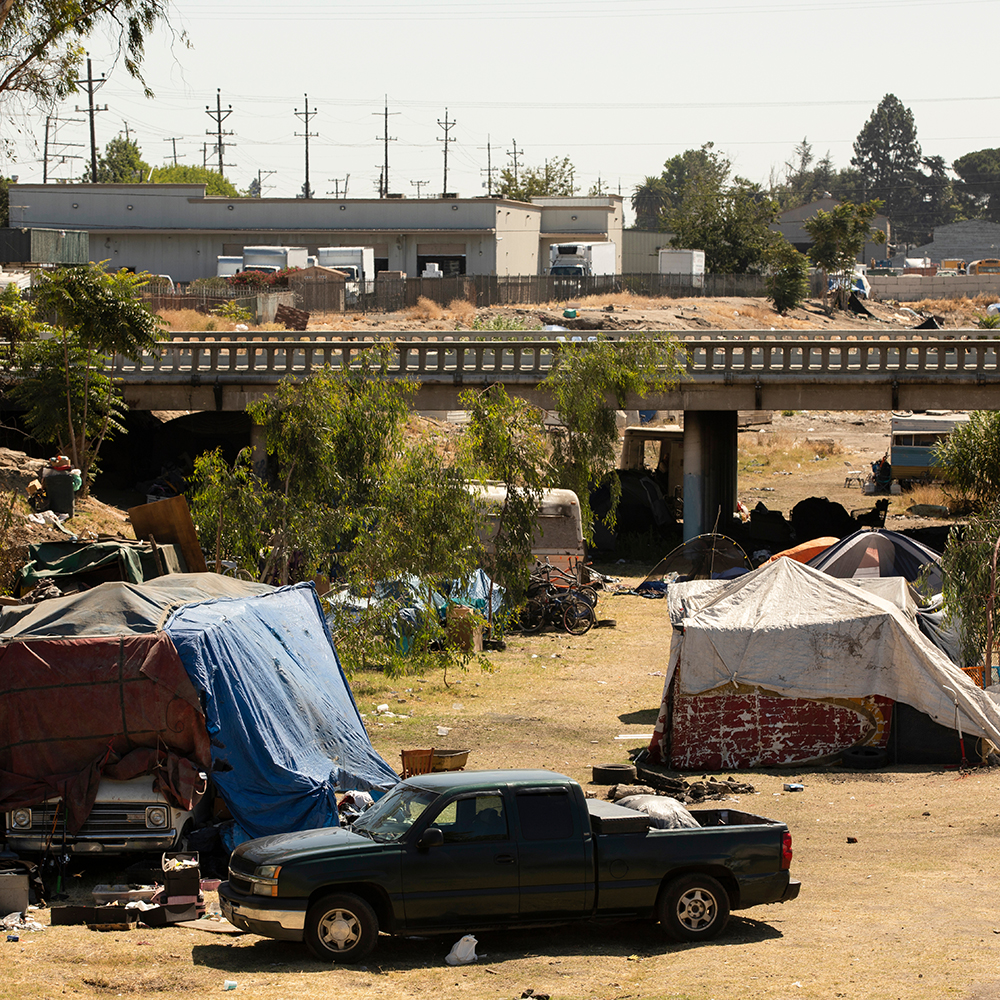
But the unsheltered, those we see wandering the streets, sleeping in filthy camps, begging at the corner — those who are too often a danger to themselves and others — do have a drug problem.
The majority, 51%, have substance abuse issues and would likely benefit from treatment.
Porter probably should have let Hilton’s statement stand and not brought on a fact-check that shows her claim is bunk.
Kerry Jackson is the William Clement Fellow in California Reform at the Pacific Research Institute and co-author of The California Left Coast Survivor’s Guide.