


The figure below displays the average monthly oil and gas prices for over three decades. It clearly shows that, on a monthly basis, oil and gas prices move in sync.
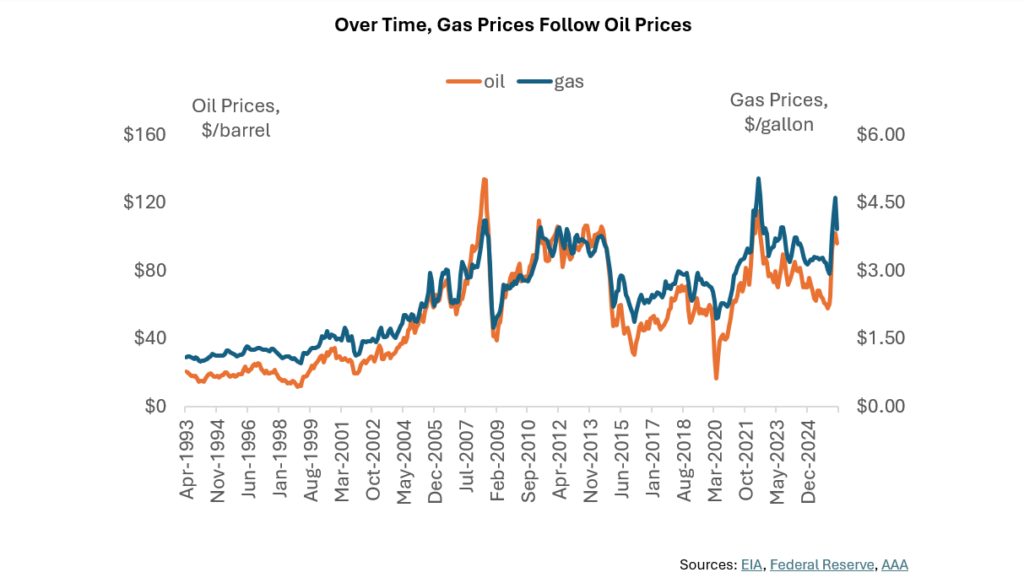
Following years of relative stability during the 1990s, oil prices began rising in the early 2000s, peaking in the summer of 2008, due to stagnant supplies and surging demands from developing economies such as China. Gas prices mirrored these movements, also reaching their highest levels during that summer with the national average eclipsing $4.00 a gallon for the first time ever.
This $4.00 a gallon threshold wasn’t breached again until oil prices spiked in response to Russia’s invasion of Ukraine in 2022. This time the national average price for gas peaked at $5.03 a gallon while oil was at its highest price in over a decade. Conversely, when oil became more affordable in the later 2010s, so did gasoline. This leads us to today.
In response to the US-Iran war, Tehran closed the Strait of Hormuz to all commercial shipping and oil tankers. Global oil markets responded predictably: oil prices increased from $64.51 a barrel prior to the conflict to a peak of $114.58. One of the main effects felt by the American public was the surge in gas prices, with the national average rising 58% per gallon.
Now with an interim peace deal on the table and the prospect of the strait slowly reopening, crude oil prices have receded. And yet, the pain at the pump remains for many Americans.
This is because the relationship between gasoline and crude oil prices follows a pattern known as “rockets and feathers”. When oil prices increase, gas prices quickly rise like a rocket. But when oil prices fall, gas prices come down slowly – like a feather.
Gasoline prices don’t move instantaneously with crude oil when comparing prices on a daily or even weekly basis. Following Trump’s claim, the American Petroleum Institute noted this delayed response is due to supply chain disruptions, refining constraints, and inventory lags.
When crude prices fall, the gasoline already in storage was purchased at a higher price, meaning sellers would lose money if they were to set prices based on current figures. The gas stations must first sell off their inventories of more expensive gasoline before the cheaper barrels can hit the pump. Additionally, it takes time for cheaper crude oil to be refined, stored, transported and delivered, typically between 2-4 weeks.
Once these market dynamics play out, gasoline prices will come down. Just as they did in 2008, 2013, and 2022.
With this understanding, President Trump’s call for the Justice Department to probe oil companies is harmful. The fear of baseless prosecution and potential penalties for normal pricing behaviors may deter oil companies from investing in expanded production. This would discourage the supply of gas and create upwards pressure on price, worsening some of the very issues that Trump seeks to remedy. Ultimately, gas prices will follow crude oil down, just slowly. Political pandering will only delay the inevitable.
Brandon Winegarden is a Research Associate at the Pacific Research Institute