

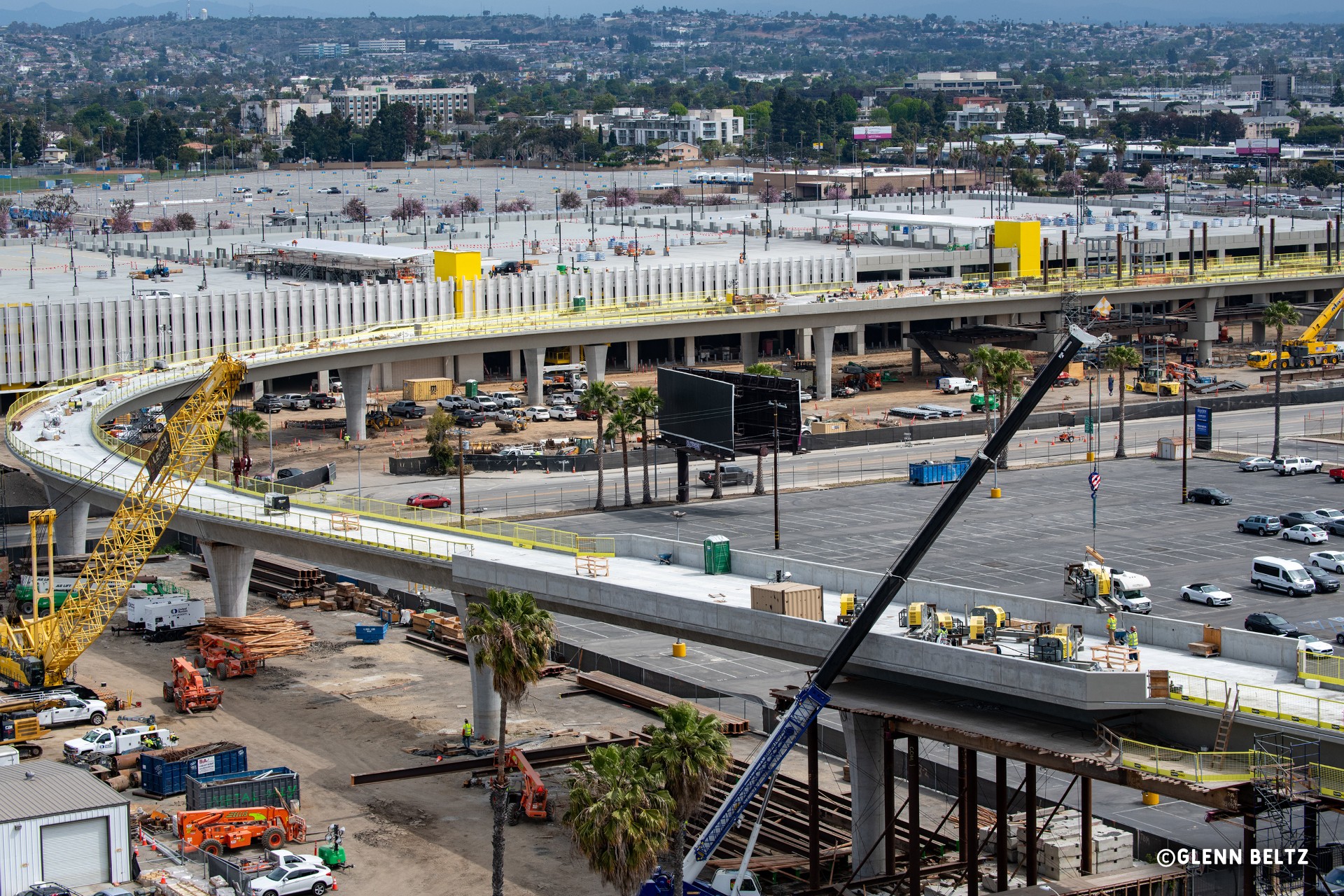
The LAX automated people mover project, begun in 2019, was supposed to be completed about three years ago, but it remains closed to service with no new opening date in sight.
The automated people mover (APM) will be an electric rail line, 2.25 miles long that travels over an elevated track linking the airport with the Metro system. There are six stations along its route, three inside the Central Terminal Area (CTA) and three outside the of it. Once operable, it will serve LAX Economy Parking, the Airport Connector station and the LAX Consolidated Rent-A-Car facility.
The expectation is that it will run 24 hours a day, seven days a week. Ticketed passengers, airport employees as well as anyone who’s picking up and dropping off travelers won’t have to pay a fare. Officials believe as many as 30 million passengers a year will use the train. While it will be a welcomed convenience for travelers who have endured changes at the airport that have made ground travel via automobile a nightmare, it seems its primary purpose is to “leverage cutting-edge sustainability practices to reduce the airport area’s carbon footprint,” according to the airport’s website.
As travelers await relief from LAX traffic congestion, they can “at least” be comforted to know that “the rolling stock is made from 98% recycled material and it uses solar power,” quips California Policy Center fellow Marc Joffe.
For now, though, it’s more of a $3.5 billion ghost train. FOX 11 Los Angeles recently “observed empty trains running on the elevated guideway, but it remains unclear when passengers will be allowed to board.” When queried about the people mover’s status, “airport officials did not return calls or emails seeking comment about the ongoing delays.”
There’s speculation that the APM might not be ready for the FIFA World Cup games scheduled for SoFi Stadium in Inglewood during June and July. That would reflect poorly on the city that’s hoping to show that it hasn’t lost a step when it hosts the 2028 Summer Olympics.
Part of the delay has been due to a fight between the city and the private consortium that’s part of the joint venture over system maintenance, reports LAist. The conflict is apparently the latest in “a long series of disagreements between the city and LINXS, the group of companies contracted to design, build and operate the train, that have led to the ongoing saga of delays, hundreds of millions in cost overruns and diminishing public confidence that there’ll ever be a rail-only connection to LAX.”
This strongly suggests there’s been too much government in an unbalanced public-private partnership.
Fox 11 says the project was 96% finished in 2024. Though it shouldn’t have taken another two years to finalize that last 4%, even a 2024 opening would have still been late. Initial forecasts promised a 2023 completion date. At this point, it’s naive to put any faith in that announcement.
It’s just another example of incompetent execution of public works projects in California. The state has come a long way — in the wrong direction — since the 1950s and 1960s, when governments saw building as a feature rather than a bug.
Kerry Jackson is the William Clement Fellow in California Reform at the Pacific Research Institute.