
SACRAMENTO – Sweeping changes to California’s criminal justice laws have undermined crime victims’ rights, reopened long-settled convictions, and placed growing burdens on the state’s courts, according to a new issue brief released today by the California-based, nonpartisan, free-market think tank, the Pacific Research Institute.
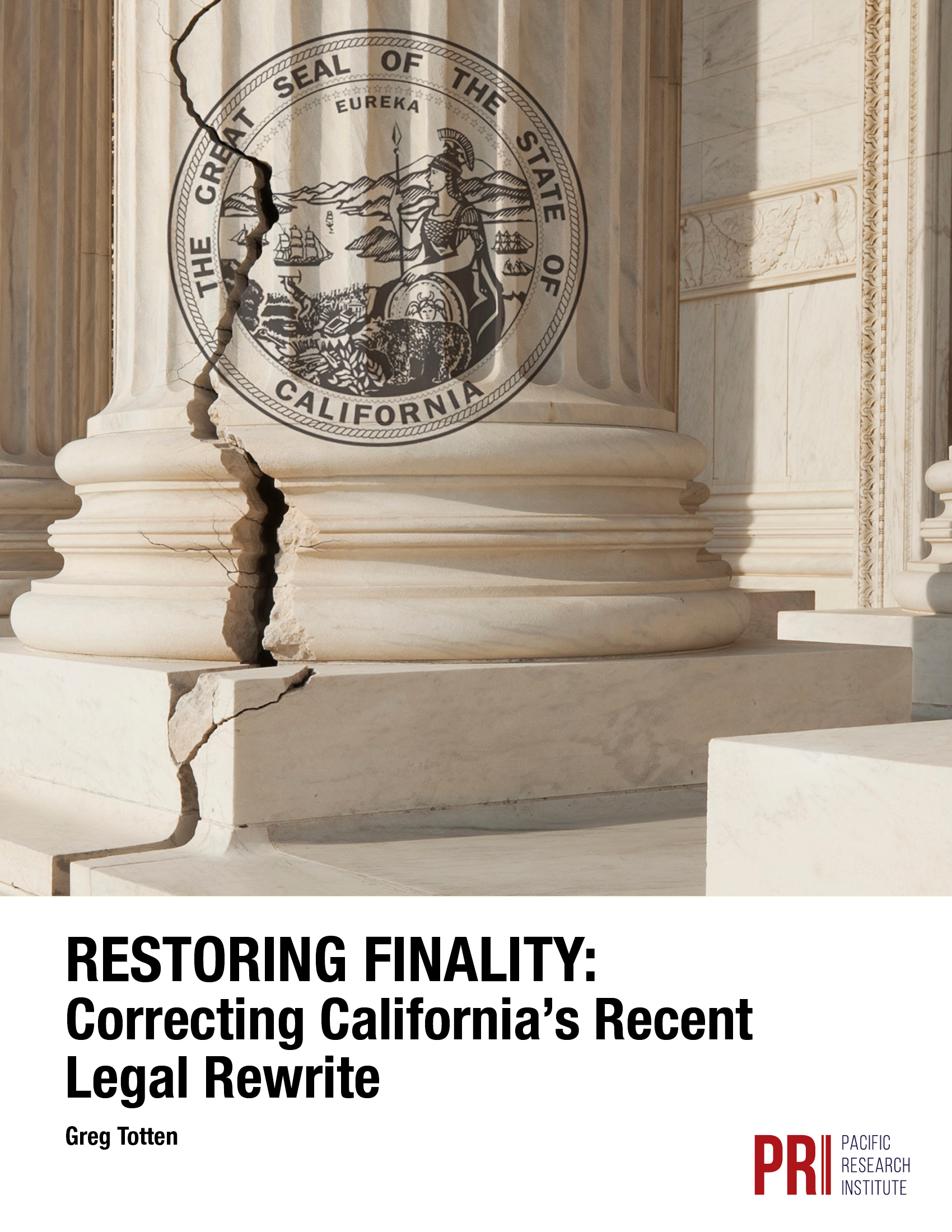
The issue brief, Restoring Finality: Correcting California’s Recent Legal Rewrite, authored by Greg Totten, chief executive officer of the California District Attorneys Association and former Ventura County district attorney, examines how recent criminal justice reforms have weakened the longstanding principle of finality in criminal judgments and sentences.
Click here to download a copy of the issue brief
“Finality is not a bureaucratic technicality; it is the spine of the criminal legal order—the safeguard that ensures verdicts have meaning, that justice eventually comes to rest, and that the system retains credibility not only for defendants but also for victims and the public,” writes Totten.
In the issue brief, Totten argues that the repeated reopening of criminal cases, sometimes decades after convictions, creates uncertainty for crime victims and their families while consuming limited judicial resources. These changes also threaten rights guaranteed to victims under California’s Marsy’s Law, which expressly recognizes their right to finality in criminal cases.
Between 2011 and 2025, California enacted more than 70 major criminal justice policy changes, many of which expanded opportunities for resentencing, early release, and post-conviction challenges. The issue brief examines three areas of particular concern:
- Retroactive sentencing reforms: New laws that have allowed previously settled convictions and sentences to be reconsidered, creating additional litigation and uncertainty for victims.
- The Racial Justice Act: These expanded legal challenges to criminal convictions have generated substantial new workloads for courts and prosecutors. California’s Judicial Council estimated that trial courts would receive approximately 5,000 claims in 2025, with more expected following the law’s full retroactive application in 2026.
- Expanded parole eligibility: California allows youth offender parole consideration for eligible individuals who committed crimes before age 26 and elderly offender parole consideration beginning at age 50 after serving 20 years, including for certain serious and violent offenders.
The issue brief argues that these changes have weakened public confidence in the criminal justice system by making sentences increasingly subject to reconsideration, even after defendants have exhausted their original appeals.
To restore accountability and protect crime victims’ constitutional rights, the issue brief recommends limiting further retroactive changes to criminal sentences, reforming the Racial Justice Act to respect constitutional standards, and restricting expanded parole eligibility for serious and violent offenders. It also calls for greater transparency and accountability in tracking the costs and outcomes of post-conviction proceedings.