

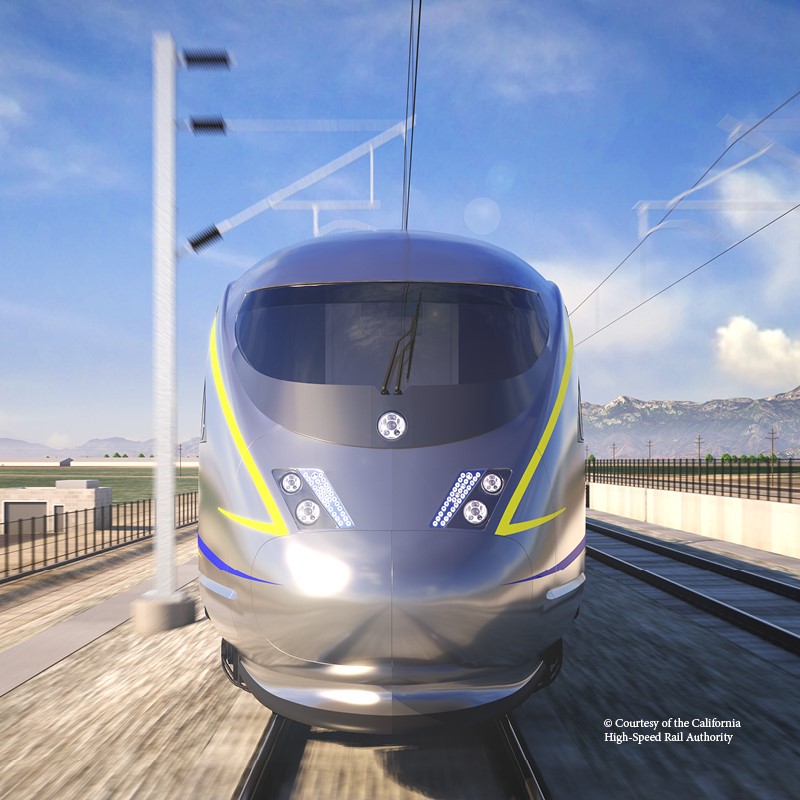
The Fresno Bee reports that streets in the center of city would have to be rebuilt as a series of overpasses and underpasses to avoid the road-level tracks for high-speed rail. The city was under the impression, based on a 2018 agreement, that the streets would remain as is while the train would travel on elevated tracks “approximately 35 feet higher than existing ground elevation.”
The Shafter City Council rejected the proposal at a meeting with HSRA officials, with Mayor Chad Givens saying that he felt the town was being treated more poorly than other cities and indicated that he’d rather the train just “go around the city” rather than disrupt it with massive street modifications.
Residents were wound up, too. One asked the city to “please protect us from the wolves who are trying to ravage our communities with overpasses, underpasses and broken businesses.”
While HSRA officials and the city of Shafter sort out their differences, federal funding is at risk and might never materialize. The Trump administration, citing a history of “mismanagement and incompetence” that have produced “a decade of failures,” is holding back a $4 billion grant that the Biden administration had authorized.
Has there ever been a more bogged-down public works project in the U.S.? Connecting the country’s East and West coasts by rail in the 1860s was a high school dance compared to the grind that has consumed California’s bullet train.
Washington’s current view of California’s attempt to do what others have done in less time and at more reasonable costs is not outlandish. The price tag has grown from the $9.95 billion in the Proposition 1A bond proposal passed in 2008, and $33 billion overall, including federal and privately raised dollars, to $135 billion – despite the fact the rail has been scaled back from its original length, speed and travel times. The U.S. Transportation Department says that’s enough money to buy every resident of San Francisco and Los Angeles “nearly 200 roundtrip flights between the cities.”
Cost seems to be of little concern for supporters, though. Gov. Gavin Newsom’s response to the loss of federal funds was to take the administration to court to stop it “from derailing America’s only high-speed rail actively under construction.” Rather than seeing the logic behind the Transportation Department’s explanation, Newsom called it “yet another political stunt to punish California.”
When voters approved the rail in 2008, they were failed by politicians and activists who did not adequately perform the due diligence needed to ensure the project would not repeatedly stumble. Consequently, the high-speed rail has become a running joke across the country because it’s not running and won’t be for some time.
Kerry Jackson is the William Clement Fellow in California Reform at the Pacific Research Institute.