
Despite the Rhetoric, Newsom’s Revised Budget Confirms That California’s Budget Troubles Are Just Getting Started
Wayne Winegarden
May 2026
With the release of the May Revise, budget negotiations between the Governor, Assembly, and Senate will now kick into high gear. Tax revenues for the current fiscal year are better than expected. Still, fiscal discipline is required, and when it comes to fiscal responsibility, Gov. Newsom talks a good talk, but even a cursory review demonstrates his updated budget plan is reckless.
Let’s start with the supposed $1.8 billion spending reduction he highlights. This figure is not an actual spending cut. It is a reduction to the spending increase he proposed back in January. Compared to the current Fiscal Year 2025-26 budget, Newsom wants to increase total General Fund spending by 8.0 percent to $246.6 billion. Worse, when all funds are included, the May Revise proposes an 8.8 percent spending increase. In total, the state would spend $349.4 billion in the coming fiscal year, which is even more than the $348.9 billion proposed in the January budget.
If adopted, this would be a fiscally irresponsible spending plan. It means that under Newsom’s watch, total spending will have increased by nearly 70 percent. General Fund spending alone will have increased by $100 billion compared to 2019!
While it is booming times for the state budget, Californians’ personal budgets are not doing nearly as well. During Gov. Newsom’s tenure, personal income in California has been growing around 30 percent slower than the growth in state spending.
The May Revise would also increase the burden on job creators by capping corporate tax credits and expanding the sales tax to target business-to-business transactions. The cascading impacts from these tax increases will worsen the state’s current affordability problems and discourage future economic growth. Newsom has also proposed some tax reductions, such as the proposed 50 percent cut in the annual $800 business filing tax for new businesses over the next three years. But these tax cuts are small, tightly targeted, and do not meaningfully improve the state’s anti-growth bias.
KEY TAKEAWAYS
- Newsom’s May Revise would increase state spending from All Funds by nearly 9 percent in the coming fiscal year. It is not a fiscally responsible budget.
- Since taking office, Newsom has expanded the budget by nearly 70 percent, which is much larger than growth in residents’ income.
- The lack of current spending restraint increases the likelihood that the next governor and legislature will turn to tax increases to cover inevitable future budget deficits.
- Closing just half of the projected deficits with increases in the top personal income tax rates would reduce the growth in the average household’s income by nearly $1,050, reduce total job growth by nearly 140,000, and diminish the growth in state’s economy by nearly 2.1 percent.
As a result, even with Newsom’s fiscal discipline, total state spending for the upcoming fiscal year will likely once again outpace the growth in personal income, or the private sector’s ability to fund the state government. Consequently, next year’s budget is primed to worsen the state’s long-term fiscal health.
Making the fiscal situation more tenuous, Newsom’s spending proposal has not yet been reconciled with the legislature’s wishes. Senate Democrats, acting as if Santa Claus works in Sacramento, want to spend even more money. More money on schools. More on global climate change programs. More Medi-Cal expenditures on undocumented immigrants. More, more, more.
Their budget plan does note that spending reductions are necessary but then claim that the “specifics of the spending reductions will be developed through the budget process.” Vague promises of spending reductions never result in actual savings for the taxpayers.
The Assembly Democrat plan is not much better. It also recognizes that the state’s fiscal future is ”under incredible pressure.” Yet, like the Senate Democrat plan, the Assembly document focuses on where the Assembly should spend more money rather than on how residents can get better government services for less. The likely result will be more spending and less fiscal responsibility.
Unsustainable Revenue Surges Cannot Fund Long-term Spending Increases
California appears to be entering the tail-end of its typical budget cycle. As we documented in our previous Spending Watch analysis, California’s excessively volatile tax system closely mirrors the surges and declines in the Nasdaq index. Since the stock market has been on a tear, California’s tax revenues are booming. According to the Legislative Analyst’s Office (LAO), tax revenues are around $25 billion higher in the current fiscal year than expected.
Soaring state tax revenues are often a sign that a frothy stock market will soon underperform. Income tax revenues, which are now abundant, could soon become scarce. While the good revenue times may not last, the excess spending that Gov. Newsom and the legislature have authorized will. The consequences will be large future budget deficits. According to the LAO, California risks years of budget deficits in the $20 to $30 billion range.
The lack of fiscal discipline today makes closing these future budget deficits even harder. Should future policy leaders turn to significant tax increases to close this gap, a growing risk, then the Golden State’s economy will suffer. For instance, closing about one-half of the LAO’s expected budget deficit requires a 1.5 percentage point increase in the top tax brackets (9.3 percent bracket and above) – a policy suggestion many Democratic candidates for governor could feasibly support.
5-Year Economic Impact Compared to Baseline
(population change in thousands)
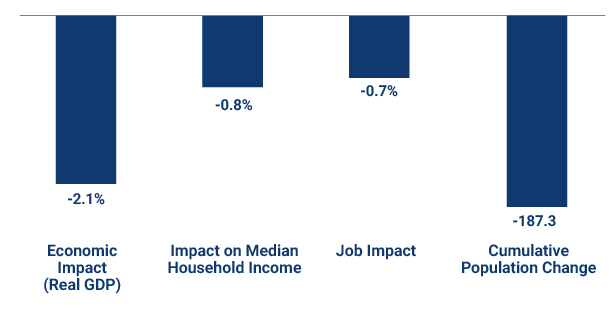
Based on PRI’s Tax and Economic model, such a tax increase would reduce the growth in the average household’s income by nearly $1,050, reduce total job growth by nearly 140,000, and diminish the growth in state’s economy by nearly 2.1 percent.
Conclusion
The unwillingness to consider sufficient fiscal discipline on the state’s profligate budget when times are good is troubling. Like the January Budget, the May Revise is setting California up for years of fiscal crises that will have to be resolved by the next governor. Should the next governor and legislature turn toward higher taxes rather than the necessary spending reductions, the adverse economic consequences will be severe.
Due to years of fiscally irresponsible budgets, a large unpaid bill is looming over Californians. As politicians continue to push off this growing tab, the costs will become larger and more painful than necessary.