

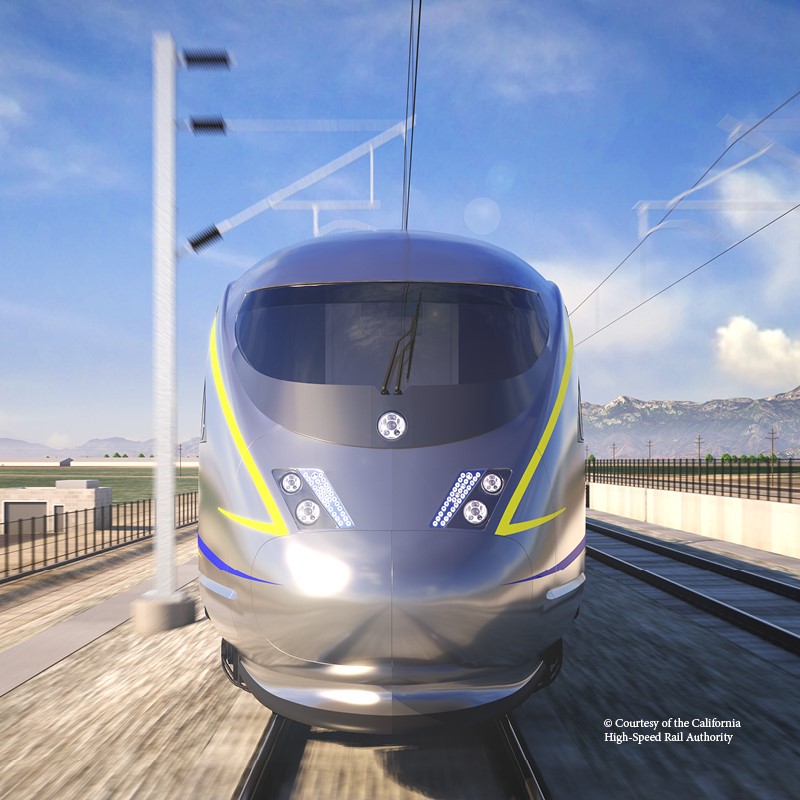
An HSRA official said the decision to pull the lawsuit was made because “the federal government is not a reliable, constructive, or trustworthy partner in advancing high-speed rail in California.”
In reality, it’s a tacit admission from the HSRA that it doesn’t deserve the money.
At this point, it’s become rather tedious to recite the high-speed rail’s catalog of troubles.
The California bullet train has been so beset with delays and makeovers that it wouldn’t be fitting if it was accidentally routed to the Nevada desert, where it hit the end of its line.
Yet like a zombie, it refuses to die and is hungry to eat the living to sustain itself: The HSRA has announced that it is seeking private capital and investors and will seek “a private partner to evaluate opportunities to leverage private sector” engagement.
CEO Ian Choudri believes, publicly, at least, that “interest from the private sector in investing in California’s high-speed rail project is strong and continues to grow.”
The 800-mile line’s price tag has ballooned to possibly as much as $128 billion and is unlikely to carry passengers until 2033.
Seeking investors isn’t a bad idea. Private capital typically forces efficiency and the so-far-undomesticated California bullet train needs to be tamed. Too bad the effort is so late.
However, the number of investors who would chance their capital in a project that has become the target of jokes couldn’t number beyond the single digits.
But they’ve known this from the beginning.
Because the train will not be a moneymaker, and will need significant subsidies, “the private sector will not invest its money” in it, say the authors of a 2013 Reason Foundation report.
“The CHSRA suggests that profits earned will induce 18% of its funding to come from private investment. However, ridership is likely to fall far short of the forecasts and there is likely to be little in profit potential to attract private investment.”
The original 2008 due diligence report came to the same conclusion, citing an analysis of High-Speed Rail Authority adviser now-defunct Lehman Brothers, which “outlined risks that can be a barrier to private investment, including cost overruns, failure to reach ridership and revenue projections and political meddling.”
The authors of a 2010 independent review wondered why “California’s world-beating risk capital firms” haven’t stepped forward with their share?”
They answer their own question, finding “the quality of the CHSRA’s work product” verged “on being promotional,” and noting that its financial documents were “not of a quality that would attract investors concerned about risks, returns on investments and the long term financial sustainability or economic viability.”
Yet the HSRA believes that it can find investors. What it’s really looking for is suckers. Proposition 1A opponents noted the billions in state bond funds were “intended to encourage” a significant private sector contribution toward construction. They then argued the word “encouraged” was nothing more than “bureaucratic language for ‘we will spend taxpayer money regardless of whether we ever get a penny from the private sector or the federal government.’”
If the HSRA believes it can make up the lost $4 billion through private investment, it is deluding itself. Recovering even 1% would be remarkable. Even more remote is raising the tens of billions needed to complete the scaled-down project. So, California either gets a monument row of tombstone-like abandoned concrete pillars or a millstone of new taxes to drag the project across the finish line at some.
Both are ugly but only one has the potential to wreck the economy.
Kerry Jackson is the William Clement Fellow in California Reform at the Pacific Research Institute.