

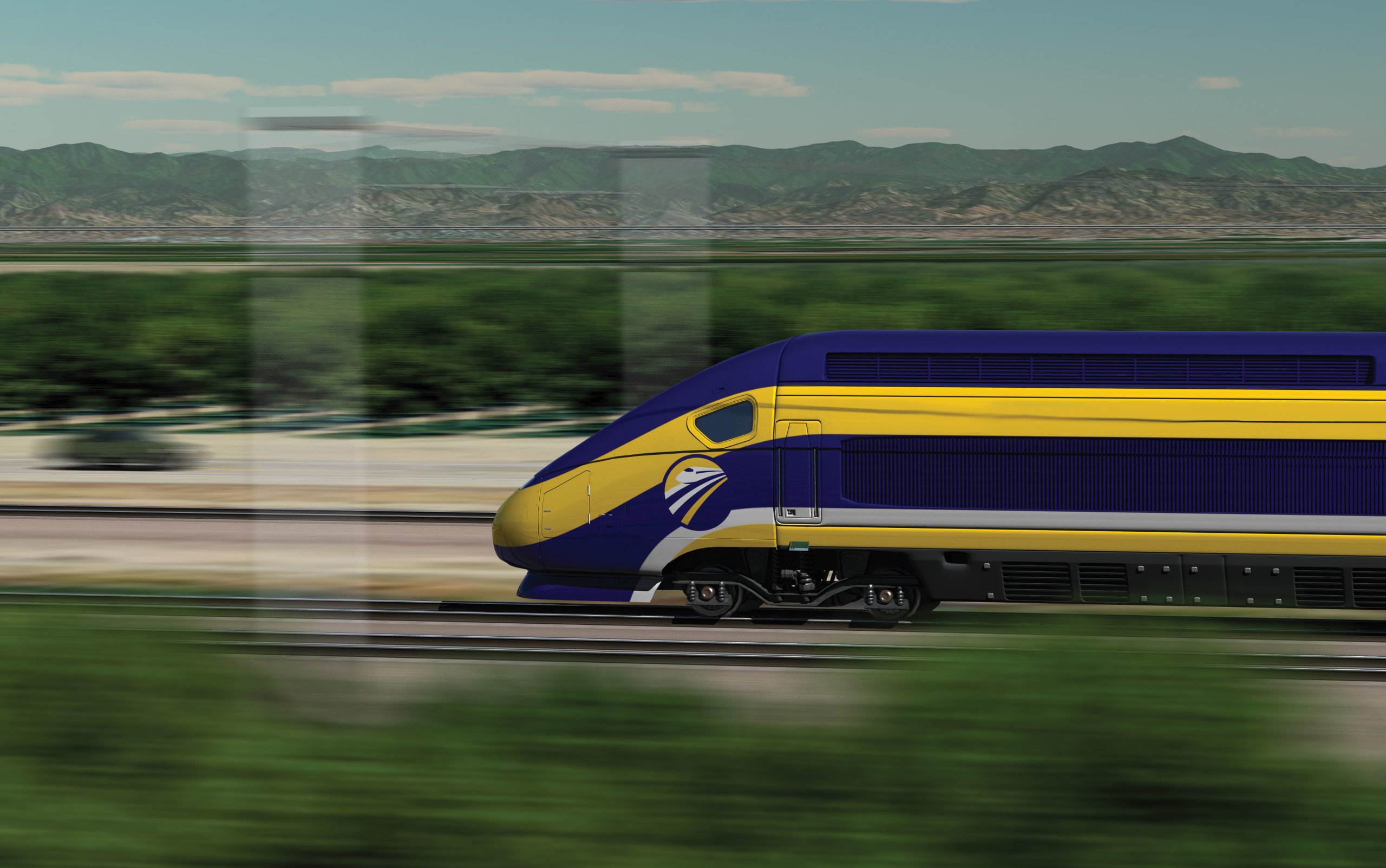
The high-speed rail (HSR) community had a tough 2025.
In April, the Trump administration nixed a $63.9 million grant to “the Amtrak Texas High-Speed Rail Corridor previously known as the Texas Central Railway project.” Justifying the decision, U.S. Secretary of Transportation Sean Duffy explained that if “the private sector believes this project is feasible, they should carry the pre-construction work forward, rather than relying on Amtrak and the American taxpayer to bail them out.”
August saw the cancellation of “two grants totaling over $26 million” for the Baltimore-Washington magnetic levitation project, after “nearly a decade of poor planning, significant community opposition, tremendous cost overruns, and nothing to show for it.”
A few weeks later, the White House withdrew funding for “California’s High-Speed Rail boondoggle,” saving “the American people over $175 million.” And two days before Christmas, the Golden State abandoned its legal challenge to the snub, in favor of a Hail Mary effort to find a “private partner to evaluate opportunities to invest and deliver the project faster and more efficiently, while commercializing assets … at the earliest possible opportunity.”
So is it the end of the line for the quixotic quest to connect America’s cities by “bullet” trains? If only.
HSR boosterism long predates the Obama and Biden administrations’ infrastructure subsidies, and it will surely outlast Donald Trump’s second presidency. The technocratic dream goes back to the Great Society, and its dead-enders show no sign of capitulation — especially given the likely outcome of November’s congressional election.
In 1965, spurred in part by the success of Japan’s Shinkansen, D.C. enacted the High-Speed Ground Transportation Act. Signing the legislation, Lyndon Johnson boasted that the nation has “airplanes which fly three times faster than sound” and “television cameras that are orbiting Mars,” but lamented that “we have the same tired and inadequate mass transportation between our towns and cities that we had 30 years ago.” The president thanked “one of the best Congresses in the history of this country” for “anticipating the problems of the 20th century” and approving a “coordinated program for improving the transportation system that we have today, and making it a better servant of our people.”
Over six decades — and tens of billions of taxpayer dollars — later, not a single American train meets the International Union of Railways minimum HSR standard of 155 miles per hour. (Amtrak’s behind-schedule “NextGen Acela” revamp is underway, and it promises to attain a top speed of 160 mph. We’ll see.) In 1984, the American High Speed Rail Corporation, which aspired to build HSR from Los Angeles and San Diego, imploded. In 1994, the Texas TGV Corporation defaulted on its franchise agreement to construct a Houston-to-Dallas line.
In 2004, Floridians voted, overwhelmingly, to repeal their 2000 decision to put a HSR requirement in the state constitution. And in 2011, the Sunshine State’s governor turned down $2 billion in federal freebies to link Orlando and Tampa via HSR. As for California’s current boondoggle, what more need be said?
Analysts cite a number of factors for HSR’s fizzle in the U.S., including the larger distances separating major metro areas v. their counterparts in Asia and Europe, how air-travel deregulation dramatically lowered fares, the myriad offerings of inter-city bus companies and the ubiquity of the nation’s automobility.
And yet HSR planning, advocacy and subsidies remain. The North Atlantic Rail “vision” seeks the formation of a “federal-state public-benefit corporation” to build an “inland high-speed rail route between New York and Boston via Long Island, Hartford, and Providence.” (It includes a 16-mile-long tunnel beneath Long Island Sound!) A “partnership between the North Carolina Department of Transportation and the Virginia Rail Passenger Authority” plans to “provide high-performance passenger rail services connecting communities from Raleigh to Richmond.” The Illinois High Speed Rail Commission pursues “a network of great, electrified trains that reconnect the region’s major cities.”
But the HSR proposal likeliest to become reality is unquestionably Cascadia High-Speed Rail, “a unique partnership between the states of Washington and Oregon, and the province of British Columbia.” The proposed line (2017 construction-cost estimate: up to $42 billion) would run from Vancouver to Seattle to Portland. Chosen as a federally designated HSR corridor in 1992, the route suffers from less-than-ideal population density and challenging terrain. But it polls well, and some very heavy hitters support HSR in the Pacific Northwest. Microsoft, headquartered in a suburb of Seattle, is a vocal fan. It’s contributed more than half a million dollars, so far, to study the proposal. “Shrinking the distance between Seattle, Vancouver, BC and Portland will encourage greater collaboration, deeper economic ties and balanced growth for years to come,” a senior executive claimed in 2018.
Many others in the “business” community are on board. At a 2021 hearing on Capitol Hill, the president and CEO of the Seattle Metropolitan Chamber of Commerce testified that, “[f]ast, frequent, and reliable rail is an economic competitiveness tool for any region,” a “significant tool in our efforts to combat climate change” and “an investment in equity.” Right as it left office, the Biden administration awarded the Washington State Department of Transportation $49.7 million for “corridor identification and development.”
Come November, Cascadia High-Speed Rail might have hope for more federal generosity. The GOP appears likely to lose control of the House of Representatives in the midterm election, and increasingly, it appears that the Senate is in play. If Democrats win a majority in the upper chamber, Maria Cantwell, D-Wash., will take command of the Commerce, Science, and Transportation Committee. More importantly, Patty Murray, D-Wash., will chair the Appropriations Committee. Both are vocal supporters of Cascadia High-Speed Rail, and both senators enjoy top-10 seniority status.
America just can’t kick its addiction to the image of gee-whiz, super-speedy intercity travel by train. But if it’s true that misery loves company, at least long-suffering California taxpayers, wondering how their HSR project went so wrong, could soon console their counterparts just up the coast.
D. Dowd Muska is a researcher and writer who studies public policy from the limited-government perspective. A veteran of several think tanks, he writes a column and publishes other content at No Dowd About It.
(Image credit: California High Speed Rail Authority)